Ways to Ensure Profitability with 7Search

It’s the New Guy, back again with lessons learned and wishing to share my insight with you. I’d like to believe that the most effective way to go about doing things is with a balanced effort. I try to balance my life out physically, emotionally and mentally in order to maintain a positive feeling of accomplishment and direction.

In my opinion a balanced approach could be used for helping your campaigns convert well on 7search. Balancing out all the factors it takes to create sales and generate revenue for yourself or your company is pivotal to this system. These components include bidding competitively, picking the right keywords, choosing the most effective match type, editing your ad copy, monitoring your progress, examining your results, and adjusting as you go.

7Search has taken steps in redesigning the Dashboard and improving the advertiser interface. This was accomplished with the redesign of the 7Search Advertiser page. In my opinion, this is designed specifically for novice computer users, not just advertisers new to the field. It is set up to ensure that you are able to methodically fill out your campaign correctly and fully. The language is clear and it is also very well organized for easy comprehension. Having this kind of hands on ability gives the advertiser the tools to conduct ad testing to help make sure they are running the most profitable campaigns.

Another step in creating a “zen-like” balance for 7search campaigns is picking the right keywords. When selecting keywords, be sure to add those with the highest volume of monthly searches whenever possible and be sure that they are relevant to your products and services. Perhaps you have a product that belongs to a specific niche. Consider thinking outside the box. One example is a person who is selling designer clocks. Try to think the way your target customer would think when searching online for your item. It is more likely that a niche product shopper will search for a very specific style or brand. Add these keywords to your list to capture searches that may have been missed by your competition. Thinking outside the box with regards to keyword selection helps you to look at your product in various ways from the point of view of a web surfer.

The next factor to consider when creating campaign balance is your bid. For best results, it’s always recommended that you bid for top 3 positioning for each keyword if your budget allows it. This provides your ad the best visibility on both 7search as well as our affiliate network which provides approximately 80% of our traffic. It differentiates your site from your competitors, and increases the chances of achieving conversions. To bid as competitively as possible, use our SmartBid feature as a guide. This amount indicates the average bid necessary for your ad to appear across our affiliate network to gain added exposure.

Let’s consider extended match options as the next step in creating well balanced campaigns. When starting a campaign, choosing the “broad” match option gives you the best chances to drive the largest amount of traffic to your site. As your campaign progresses, consider whether or not it would be beneficial for you to change your match option to “phrase” or “exact,” which may reduce your traffic but will also prevent irrelevant searches from reaching your site.

Finally, the most important step in creating balance with 7search campaigns is to remember to monitor your campaign. So many times, our advertisers make their selections and then fail to adequately review their campaign’s progress. If you should be outbid by another advertiser, your bids will fall in rank and this will cause your click-through ratio to decrease as well. While reviewing your bids, check to make sure that you have not bid higher than necessary which will have a negative impact on your return. Additionally, stay in tune with keeping your ad copy and description updated as your product/services change. Outdated information may drive up your advertising costs by causing you to receive clicks that are no longer relevant to your site.

Your campaign is your business. In order to get the most out of your investment, your ad needs to stay sharp, enticing and easy to find. The steps to creating a well balanced 7search campaign are basic, but should be stressed often so that they become a regular part of your campaign management routine.

Five Categories of CPA Offers that are Converting.

Time for our round-up of highly converting offers and ideas how to convert them even better.  If you aren’t trying new offers and new techniques and just relying on a “proven” converter, you’re going to find yourself eventually scrambling to make up for lost time. Also, try new networks that you’ve never worked with before, you’d be amazed how sometimes the same offer on a different network converts completely differently—especially with the huge advances in affiliate tracking software. So, without a delay, here are some of the offers that I think you need to take a look at.

First of all, if you’ve not tried anything in the insurance sector, you are missing out. Everyone is always looking for auto insurance, and perhaps one of the top companies out there right now pushing insurance is CPAWAY.  They are fast becoming known as the insurance superstars with tons of offers in the insurance category.  Obviously car insurance is a great place to start, everyone is looking for a cheaper quote and just reminding them that it cost nothing to search for a cheaper insurance plan is a great way to get people attention.  Also, with all the news about health insurance, this is a great time to inform people that very soon they will be required by law to buy health insurance.

Wonder what happened to all the trial and rebill offers? As you may have read, there was some serious issues with these offers and many companies stopped running them for fear of not getting paid. However, these offers are hot again and performing amazing after not being out there that much in the last year or so. If you’ve been curious who is still running them, you need to check out EnvyusMedia a company with tons of legit trial rebill offers. One of the good things about working with EnyvusMedia is their dedication to paying affiliates—as their CEO put it, they will pay their affiliates for traffic all the time, even if they aren’t getting paid. This is found few and far between in the industry, and one of the reasons that EnvyusMedia is growing very fast. Health and Beauty will always be hot, but expect as we get back into the summer that the diet health products start picking up seriously. It’s been a cold winter and when the spring comes, people will want to be taking off the fat more and more.

One proven success is trying all the “as seen on tv” offers, especially when they are being heavily promoted. If you seen the “WonderFile” and “Bionic Hearing System” (from Axon)   promoted late night, you know that these can sell amazing. I’d look at these offers and  seriously check out late night tv and see what is selling. If you are seeing a product promoted over and over again, it means that it’s currently very hot and a perfect time to try it via email, search and other systems. More and more people will remember a product and then go online and search for it, and if you can get in there to sell it first you’ll be the one making the serious dough.

Last of all, it’s time for international surveys.  While the US market is still hot, international surveys are amazing. The first reason is simple: many, many of the countries have tons of cheap inventory in display, search (especially alternative search and PPC engines such as 7Search) and even email that is readily available. The second reason is that for some reason, people love filling out those forms and it can make you quick money fast. The King of Surveys right now is PointClickTrack and they have surveys for almost every country.

—–

Learn about Dating Affiliate Programs, and other programs that always work. Also check out Email Subject Lines that always work.

Five Must Have Marketing Books for Affiliates

I’m not normally someone who pitches books to people, since I believe that a lot of information can be found on the internet for free. That being said, my parents actually gave me a Kindle for the Holidays and because of that I’ve actually started to read again. So here are  Five books that are “must have” books if you are involved in marketing. I’ve linked to the paperback versions of the books, but highly recommend also getting the kindle versions. That being said, I highly recommend also, if you haven’t already have one, getting a Kindle. Please note, I actually own (on the kindle) all these books and have read them.

Landing Page Optimization: The Definitive Guide to Testing and Tuning for Conversions
Tim Ash is one of my heroes, if only because he’s managed to look really good bald, something I’ve been working on for a year now.

Always Be Testing: The Complete Guide to Google Website Optimizer
If you haven’t been using Google Optimizer, and would like to try it, this is a great introduction. It’s worth the $18 price even if you don’t use it because it comes with $25 worth of Google Adwords 

Don’t Make Me Think: A Common Sense Approach to Web Usability
Something that isn’t talked much in the industry is Usability. Many of the techniques are basic, but understanding them completely, very complex.

Call to Action: Secret Formulas to Improve Online Results
My friend Patrick Byrne, CEO of Overstock recommends this book, and so do I.  Simply put, if you don’t know how to get people’s attention, what gets them to actually buy, you’re behind the curve.

Content Rules: How to Create Killer Blogs, Podcasts, Videos, Ebooks, Webinars

I love you Ann! Really, if you are engaged in any landing pages, PPC conversions, I highly recommend you also learn about content. Why? Just because you are sending customers directly to a landing page doesn’t mean you can’t also create content on that same site.

Learn how to Get Free Traffic

——
What are some CPA Offers that Convert?

The Google Guillotine

ADOTAS – I can’t stop grinning about Gavin Dunaway’s truth-sharing post, “Google Stands Up For Its Search“; no doubt bloggers like us “are giving big G a headache.” I applaud him for having the courage to write the truth as he sees it. (There is only ever what truth we can each deduce which the many will never agree on.)

Big G intentionally created these problems with their MFA (made for AdSense) offering that I explained in my post about Google Killing the AdWords Golden Goose and their official Google AdSense© for Domains offering that pays big bucks to people who have littered the Internet with parked domains full of canned ads.

These tactics are what PPC (pay-per-click — i.e. AdWords and similar ads) experts call distribution fraud because advertisers can not opt out of them and a page full of canned searches is not a search and will not convert like a search. (If anyone can provide proof that these do convert I invite them to send it to me and I will publish it.)

Another “groan-inducing defense” that is getting old is the company that creates the problem claiming they are “fighting” the problem. Oh please.

Big G is trying to “clean up” the Internet to favor big brands and that has very serious implications for small local and e-commerce businesses and bloggers alike. I commented in this post on SEOBook by Aaron Wall regarding the now-famous Internet Cesspool quote on what I believe their CEO meant.

The Google MayDay update slammed e-commerce sites. The PageRank update that occurred over this past weekend G-slapped my blog for the first time. That is not surprising because I am firmly in the DoFollow, CommentLuv, KeywordLuv camp and am a champion of supporting small businesses. Because of that, my posts have a ton of outgoing links in the comments.

Allowing those links runs contrary to what Big G wants, but bloggers like me should hold fast to doing what is right and not what G wants because reversing this economic decline requires understanding that marketing is not evil — it is how we find what we want and need from non-big-brand companies.

That last link contains statistics that clearly show what is destroying economies around the world and what we — those of us who are willing to make better decisions — can do to reverse that. I encourage anyone reading this far to open that last link up and read those statistics so they clearly understand how dangerous not changing our shopping behavior is.

By moving the dollars we currently spend to small local and online businesses, we can create buying communities that may escape the worse of the inevitable collapse of the U.S. dollar. Anyone who believes that the economy can recover is in for a huge surprise. As many have been quoted as saying throughout time, “Those who ignore history are doomed to repeat it.”

The handwriting is on the wall and easily interpreted if we only look around and read the excellent information available on the Internet — much of it compiled in “What Caused the Great Depression is Now.”

The monopoly Google has on both organic and paid search — clearly seen in this spreadsheet of Google market share by country — gives them a guillotine over the heads of every business, blog and website owner. They are also behind serious threats to net neutrality that could further favor those with deep pockets and cripple independent websites of all kind.

We Internet users have collectively handed them this guillotine and only we — by using alternative search engines — can take it away from them.

——

Gail Gardner is a Social Media Marketing and Internet Strategist at GrowMap.com. Follow her on Twitter here.

Affiliates Need Face Time

ADOTAS – Even though it’s early February, you might still be recuperating from Affiliate Summit West in Las Vegas. If you weren’t there – big mistake!! The affiliate community was out in force (more than 4,600 delegates), taking part in the mayhem that Vegas has now become renowned for – endless seminars, impromptu networking, crazy parties and casino games beyond your wildest dreams. Safe to say, you need a vacation after the show to fully recharge your batteries before you can get back to business, but it’s so worth it.

For affiliates who work independently or with a small team, a conference is paramount to maintaining their sanity and reigniting their zest for the career they have chosen. You could feel the buzz in the air during the entire show, and one can only sympathize with the other Wynn guests who weren’t part of ASW; there was a perpetual sea of bodies in every bar, restaurant, meeting area or hallway with those tell-tale Summit badges.

A quick scan of a badge and you’re instantly chatting with a super affiliate, a blogger, your affiliate manager, etc. Everyone is really approachable and down-to-earth, no superstars here.

For those of you spending your days pouring over performance metrics, having face time with your account manager is really important to be able to get a network-wide perspective of trends or opportunities you may see. Yes, much of this can be done by e-mail or IM, but we all know that sitting down with someone in front of data is a whole different experience than the sound-bites you might pick up when multi-tasking.

A Reciprocal Arrangement

Ad networks require truly effective listening skills to be able to deliver exactly what their affiliates need; is there a more efficient forum than a private meeting or dinner at a trade show?! If you’ve expended the time, energy and finances to attend, you should demand a positive return and assume the responsibility for achieving that.

Your physical presence will increase your recognition amongst the strategic partnerships you wish to develop and continue, which in turn may result in preferential treatment plus more regular attention from your AM.

Effective Time Management

Once you’ve made the decision to attend an industry event, don’t just leave it to chance to have a productive experience. Plan your time wisely to cover as much ground as possible and ensure that your interactions leave you with actionable take-aways, and you return home buzzing with fresh ideas to implement.

Some things to consider:

  • Schedule meetings with your network AMs, and if possible get an introduction to their Department Head. Find out what’s hot on their network, successful campaigns with other affiliates working in your space, discuss your anxieties about testing new categories and get their opinions. Are there any product enhancements in the pipeline and how can you get advance notice of such developments? Identify some common ground, maybe a sporting interest, leisure pursuit – this will give you an edge and help put you on their radar of “memorable” clients.
  • Attend relevant workshops. Identify key industry trends (blog monetization, the impact of social) or regulatory updates and see which sessions can make you more efficient and productive in the pursuit of your revenue goals.
  • Networking. Whether you target some key super affiliates (maybe you’re looking for a mentor?) or just want to meet like-minded individuals to brainstorm and share ideas with, this is the real beauty of a trade show.

The next time an “Affiliate Dream Team” is assembled, use the opportunity to block out some time and consider it a worthwhile educational/networking expense; better still, include it in your personal ROI calculations and await the returns. If 2011 trumps last year’s online sales, you’ll want every tool possible to claim your slice of the pie.

—–
Greg Bayer is general manager of the affiliate division for Adknowledge and has over 15 years experience in affiliate marketing and digital media.

3 Ways to Set Expectations at Sign Up

“I didn’t sign up for this!” An impulsive and angered hand clicks the “Mark as Spam” button.

Spam complaints can tell you a lot about your email marketing campaigns. One thing they can indicate is that it’s unclear to your subscribers what they are signing up for and how when they’ll receive your messages.

So how can you minimize spam complaints from the get-go?

Keep reading to find out how a few of your fellow email marketers do it by setting expectations!

Setting Expectations

When evaluating the cause of a spam complaint, the first step is to take a look at your web form.

It’s absolutely crucial to set expectations throughout the life of your email campaign, starting with your web form.

Your web form must explain exactly what your subscribers will receive, the benefits of subscribing, and when subscribers can expect to receive your messages.

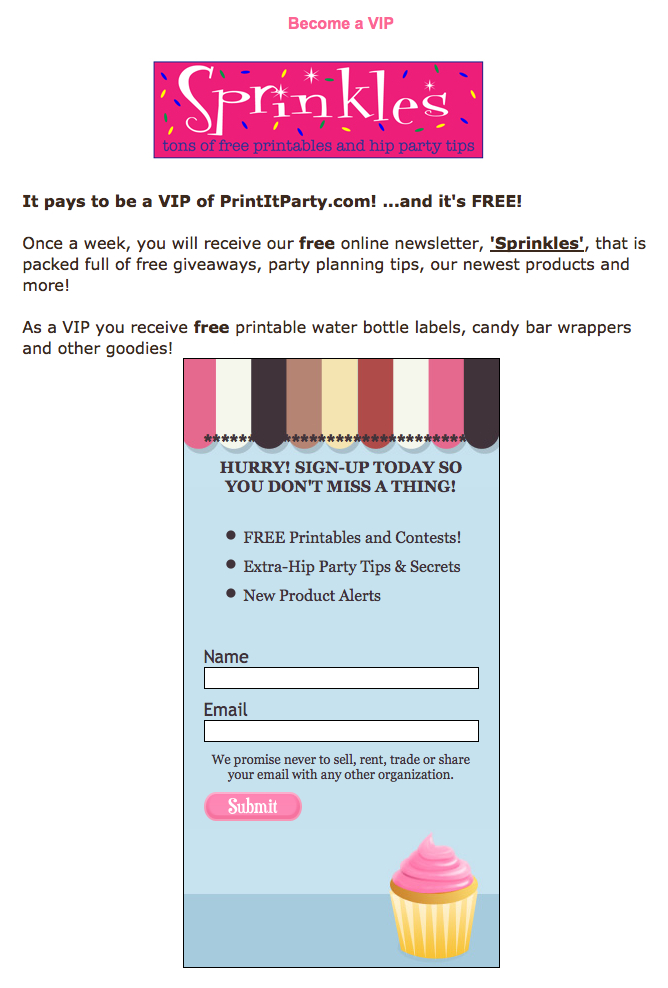
Let’s take a look at how Print It Party, a party decor site, sets expectations with their web form:

Print It Party Example thumbnailTo make certain that important details are not overlooked, they place information not only in the header of the form, but above the form as well. With your own form, if you can’t explain in full detail what subscribers will receive in just the header, include a description near the web form on the page.

This web form includes the benefits of what the subscriber will receive – “free printables and contests, extra-hip party tips and secrets and new products alerts.” They make their newsletter sound special and exciting while describing exactly what is to come.

Including a Subscriber Counter

Using a subscriber counter has shown to be a successful tool in gaining subscribers. A potential subscriber viewing the counter will see that others are benefiting from your newsletter. This establishes your information as a reputable source.

Battlefield Equipment, an equipment rental site, sets expectations using this method.

Battlefield Example thumbnailBattlefield Equipment’s subscriber counter builds trust and sets expectations about the quality of their “Battlefield Equipment eNewsletter.” Potential subscribers can see Battlefield already has a significant following and they will be more inclined to trust that the messages and content they will receive are valuable.

Just as Techbite describes when subscribers will receive messages, Battlefield notes that subscribers will get “seasonal” specials. If you do not send each week or month on a specific day, you can still use detailed words to describe “when” messages will go out.

Using Images

Including an image on your email sign up form can increase recognition and help you to maintain consistency throughout your campaign.

Take for example the web form on the homepage of the brain games and fitness company, Braintraining. Braintraining’s form includes imagery and lets subscribers know they respect their privacy.

Braintraining Example thumbnailTheir attention-grabbing lightbox form includes an image of the Brain Training Power Pack. Including this picture allows subscribes to visualize what they are going to receive.

The form also contains a link to Braintraining’s privacy policy. Include a link to the privacy policy in your own web form to assure subscribers that you are sending a safe and private newsletter.

Details Make the Difference

These forms do not simply say “Sign Up for My Newsletter.” They include valuable and descriptive information to begin an honest relationship with subscribers.

You can see a little detail goes a long way in setting expectations. To prevent potential complaints, make it your priority to set expectations right off the bat.

How do you set expectations at sign up?

Brought to you by Aweber

Seal the Deal: 10 Tips for Writing the Ultimate Landing Page

I have a client with a deep-pocket online media budget. Google Adwords PPC, banner ads on major news sites. We’re talking some sizable money to generate traffic and turn that traffic into customers. I bet you’re thinking a big part of their budget was earmarked for landing page development and testing. I would have thought so, too, before they became a client. But what I quickly discovered was this – there wasn’t a series of landing pages. There wasn’t even one landing page! All of the clicks, all of their costly PPC traffic was being directed to the homepage.

Literally, their best prospects were being dumped off at the front door with little direction or guidance as to how to proceed. Yikes.

Now just to be fair, literally any page of your site or blog is a landing page of a sort. To my mind, every page should be optimized to move your visitor along whatever path you’ve set forth toward a sale, a newsletter or blog subscription, what have you.

But for the purposes of this post, I’ll confine myself to those landing pages where your prospect initiated some sort of response to an ad. This could be a PPC (pay-per-click) ad like Google Adwords, a banner or text ad, or even an email. In this scenario, your prospect has initiated some sort of relationship with you. Your landing page acknowledges this and provides additional information – benefits/features – and a clear path to the next step.

So let’s look at 10 key steps to writing and designing a landing page that will help get you the results you’re looking for:

ON WRITING

1. Make sure your headline refers directly to the place from which your visitor came or the ad copy that drove the click. Match your language as exactly as you can. (Close is good, exact is best.) This way you keep your visitor oriented and engaged. This is by far the most important part of your landing page.

2. Provide a clear call to action. Whether you use graphic buttons or hot-linked text (or both), tell your visitor what they need to do. I use a minimum of 2 calls to action in a short landing page, 3-5 in a long landing page. Copy tests here will give you the biggest bang next to testing headlines.

3. Write in the second person – You and Your. No one gives a rat’s patootie about you, your company, or even your product or service except as to how it benefits him or her. (The bigger the company the more time I spend rewriting their stuff from We to You.)

4. Write to deliver a clear, persuasive message, not to showcase your creativity or ability to turn a clever phrase. This is business, not a personal expression of your art. (Every copy coaching student hears me say this at least once.)

5. You can write long copy as long as it’s tight. I always err on writing a little long on the first drafts because it’s easier to edit down than to pad up skimpy copy. Your reader will read long copy as long as you keep building a strong, motivating case for him/her to act. However, not every product or service will require the same amount of copy investment. Rule of thumb: Think longer copy when you’re looking to close a sale. Think shorter copy for a subscription sign-up or something that doesn’t necessarily require a cash commitment..

6. Be crystal clear in your goals. Keep your body copy on point as a logical progression from your headline and offer. Don’t add tangential thoughts, ancillary services, and generic hoo-hah. (Hoo-hah makes the client feel good but wastes the readers time.) Every digression is a conversion lost.

7. Keep your most important points at the beginning of paragraphs and bullets. Most visitors are skimming and skipping through your copy. Make it easy for them to get the joke without having to slow down.

8. In line with #7, people read beginnings and ends before they read middles. Make sure you keep your most critical, persuasive arguments in these positions.

9. Make your first paragraph short, no more than 1-2 lines (that’s lines, not sentences.) Vary your paragraph line length from here. It helps create visual dissonance and makes it easier to read your copy. And no paragraph should be more than 4-5 lines long at any time.

10. Write to the screen. Take a piece of paper and frame-out where your text, buttons, and design elements will go. Consider how much of your content will be seen “above the fold” or at the first screen. You can still go long and have visitors scroll downward. If so, you’ll want to make sure you repeat essential calls to action, testimonials and other components so no matter where your visitor is, an ACT NOW link or button remains is visible.

3 BONUS TIPS:

11. Remove all extraneous matter from your landing page. This includes navigation bars, visual clutter, and links to other sections. You want the reader focused solely on your copy, your supportive visuals, and the offer you’re making without being tempted to wander around the room.

12. Don’t ask for what you don’t need. Ask for only enough information to complete the sale or the desired action. This isn’t the time to conduct a marketing survey. Every question you ask, every piece of information you require will chip away at your response. Be judicious.

13. Assume nothing. Test everything.

These tips and techniques will get you started, but they just scratch the proverbial surface. Design elements are critical, too — color, images, layout — as well as video, audio, and other interactivity elements whose purpose is to more deeply engage the reader and boost response. They all merit a deeper look and testing where it makes sense.

Recommended Resource: The one book I recommend without reservation is Landing Page Handbook, How to Raise Conversions — Data & Design Guidelines. Published by Marketing Sherpa, this is a compendium of everything “landing page” that copywriters and designers should heed and study deeply. Not a cheap reference at $247, it is, however, the one to own if you’re serious about learning the science and technique behind great landing pages. (Alternatively, Try this Book by my friend Tim Ash)

Get more from Roberta Rosenberg at her blog, The Copywriting Maven.

Free Traffic Here.

Landing Page Optimization techniques and teaching.

Rebecca Madigan of the PMA leads her Army of Affiliates

For as long as I remember the affiliate and performance marketing industry has been attempting to create a trade organization to represent the industry. Every time they tried, it failed miserably without exception — until the Performance Marketing Association came along. At first most of the industry universally panned the idea of another organization, thinking it would be no more than a loose fraternity that allowed a few CPA network owners to drink scotch together once a year. However, with the leadership of Rebecca Madigan, the Executive Director of the PMA, the organization has become a force in the industry, fighting for the industry as a whole and providing much needed leadership. If you ask anyone who is involved with the PMA, they will tell you that one of the main reasons for its success is Rebecca and without her the industry might already just be a footnote. I sat down with her this week and asked her some difficult questions about the PMA, industry as a whole and learned that she dreams of jet planes.

How did you get involved with this industry initially? I joined CJ in early 2005 in product management. I have extensive background in product management for technology products, including broadband, telecom and wireless/mobile. I was the product manager for the first ‘voip’ product called Web Talk, a browser based Internet phone (back in 1994). When I was in wireless and mobile, I was really involved in industry and standards organizations (founding member of the Bluetooth SIG, for example), and saw first hand the benefits of a unified voice dealing with public policy (buying of spectrum) and standards (wireless LAN, GSM, CDMA, etc). It struck me as odd and limiting, along with many people, that the affiliate space didn’t have any industry organization.

Why do you think the industry needs a separate organization for “Performance Marketing?”
The industry needs AN organization for performance marketing, there is no other organization serving this business model. We tried to get others like the IAB, ERA and DMA to pay more attention to performance marketing, but those groups aren’t chartered to do so, and haven’t had an interest.

What would you say to those who argue that separating ourselves from the IAB just hurts us? Why not join the IAB? The IAB has been disinterested in performance marketing, in the US anyway. In the UK they do have an affiliate group, but nowhere else. And the IAB is structured for very large companies, or that was the case when the PMA formed. There wasn’t a long tail membership until recently. But most importantly, they aren’t chartered around the performance business model, nor do they even embrace affiliate marketing. We’re still the ‘red headed stepchild’ to them.

As we’ve talked before, the PMA represents both networks and merchants. Isn’t this combining two different groups with different goals? How can they really work together? Actually, the PMA represents the entire ecosystem of performance marketing. We have more affiliates as members than any other segment (>25%), and advertisers are represented the least (14%). We also represent networks, solution providers, agencies, and investors. The way for this industry to mature is for us ALL to work together to drive growth, change, innovation, and trust. I would argue the thing that has held this industry back is the fragmented nature, business segments unable or uninterested in sitting down together to solve problems.

Isn’t having Dell, Amazon, Google and other major players dilutes the influence and ability of smaller players and networks to make changes? As I mentioned, we have more affiliates as members than any other segment, including our top level, platinum. Publishers like FatWallet, Offers.com, RetailMeNot, and Fabulous Savings, are platinum members.

Additionally, the way we’re structured is to allow for smaller companies, specifically affiliates, to be involved, participate in working groups, take leadership roles, vote on initiatives, etc. We all feel very strongly that this industry is only as strong as the entire ecosystem, and in particular, we all need affiliates to thrive for everyone else to thrive.

Lastly, though, I’ll add that we’re an organization that is chartered with doing a lot of things. Our biggest activity to date has been fighting the affiliate nexus legislation, which directly targets affiliates. We’re also developing standards and best practices to improve quality and effectiveness, and stimulate growth (let’s make it easier where we can so companies can spend more time on the important things). All these things take enormous time, resources and money. Where does that money come from to fund these initiatives? Membership dues. The PMA is non-profit and we’re only as strong as our members and our ability to raise money.

What do you think about the growing trend of “gurus” in the industry? My main concern is that they perpetuate the concept of ‘get rich quick’, which doesn’t help our industry. Being successful takes a lot of time, patience, perseverance, talent and a little luck. We believe the way to grow this industry is to focus on long-term growth, not the quick buck.

Affiliate Summit was highly attended but there was almost no mainstream media coverage for some reason. What are we doing wrong in getting that coverage? Good question. It’s an event for industry insiders, the topics of discussion assume a certain level of knowledge (you won’t learn about what performance marketing is at the show). You might ask Missy and Shawn about that, did they invite the press?

Are we the affiliate marketing industry, or the performance marketing industry? Is there a difference? We opted to use the broader term ‘performance marketing’ for a couple of reasons. First of all, the performance model (ads being paid based on results) is bigger than just online. It has been around on television and radio for a long time. We see tremendous growth and opportunity in looking at where experts in the performance model can take it into new channels, like mobile for example. And ‘affiliate’ means something different in those channels, like a TV station or wireless carrier partner.

Secondly, for right or wrong, ‘affiliate marketing’ has a reputation burdened with lack of trust, the ‘wild west’, if you will. We’re an industry maturing into one with very professional companies, and we don’t’ want to be held back by an old reputation.

Thirdly, on the legislative front, the term ‘affiliate’ has come to mean agent or distributor or subsidiary, causing laws to be created that damage our industry. Our ‘affiliates’ are simply websites that earn revenue from advertising, they have no other relationship or level of ownership by merchants.

What is happening on the Affiliate Tax Front?  Does this really affect the “average” affiliate or just the large companies like Amazon? The unfortunate thing about this legislation is that it’s been called the Amazon tax and people think it impacts only them. The affiliates, large or small, are the unintended victims in this. The law basically says that if an out-of-state merchant has an affiliate in the state, the out-of-state merchant must then collect sales tax. So merchants simply terminate their affiliates to avoid collecting sales tax. Not only have Amazon and Overstock terminated, but hundreds of other merchants. It’s passed in NY, NC and RI, but we’ve prevented it from being passed in 15 other states. The way we’ve stopped it is through affiliate involvement – putting faces and success stories behind the name.

This is going to be a bad year, it’s already shown up in more states than this time last year (IL, SC, MS, CT, CA). States are still desperate for budget dollars and they think this is a quick fix. So we go to every state, recruit affiliates to help, and we slowly but surely convince legislators it’s a bad idea.

Aren’t you just pissing off the people in power by filling suits against the state and making the performance marketing industry look greedy? We haven’t filed a single suite against any state. What are you talking about? (BTW, we’re way too small of an association to file a suit of any kind, even if a reason arose – which it hasn’t).

What can we do as individuals to stop this trend of states taxing affiliate sales? Get involved when it hits your state. We have up-to-date information on our website.
Get to know your personal legislators. They’re very approachable and really want to learn about their constituents. If they learn about you now, and understand what you do and how this will impact you, you can build support to block progress. We’ve had this happen with affiliates in VA, IL, CA, CT, GA, TX and PA just this year. These affiliates are learning more than the lobbyists!

What is the PMA’s position on the FTC as a whole? Do you think the FTC recognizes that unique status of affiliate marketers as being different from $100M companies? What do you think the FTC will do in 2011 that might affect our industry negatively or positively? The FTC has a charter of protecting consumers from false or misleading advertising – and we support that charter completely. It’s a tricky balance between having an effective government-run regulatory agency and letting an industry self-regulate. This industry has done an awful job self-regulating, and it’s no suprise the FTC is stepping up its scope and authority.

The FTC recently published a proposal nicknamed the “Do Not Track” proposal, essentially suggesting consumers should have more say and control over how their Internet activity is tracked, and how and where personally identifiable information is used. In theory that seems fine but as we know in our industry, tracking of a user is extremely complex but also delivers the great targeted online experiences consumers come to expect.

There’s been some speculation as to why the FTC put out this proposal. My belief, and I’m not alone, is that it is a challenge to all advertising industries to step up the game in self-regulation. And we completely support that goal.

The PMA is preparing our own response to the FTC, so that we’re sure the unique perspectives of our industry are heard. The submission deadline is February 18th, and we have a volunteer member group crafting the response.

What is your dream car? I work at home and travel a lot. I no longer dream of cars but I could really use a private jet, like a G4.

Read Another Great Interview Mike Krongel of COPEAC

Higher Landing Page Conversions: Paradox of Choice

Last week we talked about a simple problem with many landing pages: too many choices. It’s simple: despite what people think, that more choices are better, it generally proves to be completely incorrect.  Noted Psychologist Barry Schwartz wrote this in his book “The Paradox of Choice.” According to most economic situations, the Paradox of Choice basically says that at a certain point that too many choices is counterproductive. In direct response however, I believe that we need to take this to a totally different level and completely remove any choices in landing pages.

In Performance Based Marketing the idea is to drive a customer to a product and get them to buy that product immediately. There are no extra points given to how many people view your page and think about it, just on conversion rates. The payment is simple, as we all know: the more people who sign up or buy the product, the more money that is made. We only care about that conversion, that is the golden goose, that is the end-game.

However, when you drive a user to the website, and there is a “choice” often it will result in the user having to think about the product, have to consider if they really want the product.   This is especially important in PPC and email campaigns, where the person has already “made the choice” of clicking on the advertisement to get to that page. They are interested in the product, you’ve already done the hard part of sending them there, the next step is getting them to buy. If you give them another choice, they are going to question their initial choice of actually clicking on the advertisement.

For example, if you created an advertisement that said “Get a $5 Large Pizza” but then then landing page has a choice of 5 other pizzas of higher values, you’d think that perhaps people would say “hey, those are good deals too.” However, the very fact that you are presenting them with higher prices might make them reconsider the initial buy and they would go “Hmm.. maybe I want something else, maybe not a Pizza” while considering their buy.  If you want to sell something more expensive, you do the upsell after they have already bought the pizza and started the order. It’s simple, they start the order for the $5 Cheese pizza, start entering their info, then you offer them the additional choices of “perhaps you’d like for $1 more some Extra Cheese” or a “Coke for $2.50.”

In Education PPC campaigns, this actually is one of the biggest mistakes on conversions. I’ve cut and paste below two EDU PPC campaigns, both for criminal justice. One of them does much better, because of the lack of choice. The person has already chosen that they are interested in Criminal Justice, but for some reason one of the online universities thinks that it better for them to give them an additional choice. They feel incorrectly that “perhaps there are people who might want a different degree.” Maybe a small percentage will look over it and decide that they really want to go to nursing, but the vast majority were looking for criminal justice school because they were sincerely interested or were thinking about it as a possibility. The school might have created doubt in their mind that this was a good opportunity, because there are so many options and their next step may very well be to search for something else.

Next week I will bring up “fake choices” — where you basically make the user think they may have choices but really are only given them one choice. It may seem the opposite of what we just talked about, but its basically the same.

Stop Bing, Yahoo, Facebook and any other type of traffic advertising.
Don’t even spend time with SEO until you try this NEW form of FREE web traffic.

—–

Learn about Landing Page Optimization

Four common issues with landing pages

Four common issues with landing pages

According to my analysis, one of these four issues (if not all) were the most common causes of poor conversion rates. As you go through the list of issues below, try to relate them to your landing page (or homepage). Here are the four most common issues that affect conversion rate and sales:

  • Too-much text (without any apparent order and layout)
  • Headline that doesn’t tell what your product or service does (or, in other words, tangential headline)
  • Lack of a single prominent call-to-action (either there is none or there are too many)
  • Lack of social proof or ROI proof (who uses the service and what are the benefits)

Let’s analyze the issues one by one.

Issue #1: Too much text

Example of a homepage with too much text

I won’t be surprised about lack of sales and conversions if your page announces “Welcome to..” followed by a bunch of three paragraphs describing what the site is about. Nobody on the web has patience to read paragraphs after paragraphs about you are offering.
On the web, people scan for elements that catch their eye. And you get only first few seconds to answer two most important questions: a) what you are offering; b) why they may need it.

Example of a balanced webpage (text + images)

So, what you need is a proper balance between graphics and text. Some examples of how you can improve your landing page (by replacing some text):

  • Instead of extensive “How this works” (consisting of heaps of text), make a simple graphic detailing the process
  • Instead of writing “We make some of the best shoes in UK” followed by description of different kinds of shoes you make, show pictures of shoes you make
  • Instead of trying to stuff every piece of information from your site on one page, concentrate on a SINGLE objective (and replace most of the text by images, graphics, etc. – all neatly arranged).

Hiring a professional web designer will certainly help if you lack design skills. On a similar note, “visually appealing” pages are always seen as more credible than “crudely designed” pages. So, an investment in a good design will go a long way helping your sales and conversions.

Issue #2: Lack of descriptive headline

Example of confusing headline: “Changing how the world works”

As I hinted in the section above, visitors on your page are impatient. Within first 5 seconds, they want to know what your service does or you have lost a chance with him/her. As someone wise said: “Browser back button is your biggest enemy” (if you find the source of this quotation, please leave a comment). Never think that a visitor is going to spend minutes reading through all text on your page and then make his best guess of what you are offering. Instead, you should make the job easy for him. Have a big, bold descriptive headline as the first thing he should see.

Example of good headline: “Hire Online Workers to get the Job Done”

A descriptive headline also serves another important job: it *sticks* in the visitor’s brain as long as he stays on your website. Contrast this to the scenario where there is no helpful headline which a visitor can fall back on if your page gets too confusing (usually happens because we want to write about EVERY feature our site offers). Moreover, your visitor is usually distracted. Imagine a “busy-beaver” visitor chatting with friends on IM, doing a status update on Facebook/Twitter and on a call with his boss, all at once. Now imagine he stumbles on your website. Do you expect him to really understand what your site does without having a descriptive headline?

My advice is to avoid following kinds of headlines:

  • No-headline: no matter how bad it is, you should definitely have a headline of some kind
  • Visionary headline: avoid headlines such as “Welcome to the future of social media marketing”. Such headlines are usually vague and convey no information at all. And if you think it may excite visitors, read last section of this article (about social proof).
  • All focus on benefits: in the first version of Visual Website Optimizer homepage, we had a headline “Magical tool to convert visitors into customers”. While that headline tells about the benefits of the tool, it doesn’t talk about what the tool really is. So, we changed the headline to “World’s easiest A/B testing tool” and believe it is much better than the other one. (Can you come up with an even better one?)

In a nutshell, headlines should be short, concise and descriptive.

Issue #3: Lack of a single prominent call-to-action

Paradox of choice on a landing page. Out of three call-to-action buttons. which option to choose?

Call-to-action is a button or link that asks visitor to take a specific action. It may be a link to your signup form, plans and pricing page or the feature tour page. There are two specific issues related to call-to-action: a) either some sites don’t have any call to action button or b) some sites have too many call-to-action buttons. Once the visitor arrives on your page, thinks that you are credible (from your design), reads the descriptive headline and is finally convinced to spend some time on your site, what’s the next page you want him to see? That decision should not be left on visitor because only you know (and not him) which is the most relevant page that the visitor should be viewing next.

Example of single, prominent call-to-action: “Download WordPress”

If you don’t have a single call-to-action or have far too many call-to-action, visitor is likely to get confused what to next (since all links from your landing page/homepage seem to be of equal importance). Even if you have two prominent buttons (e.g. one of Learn More and other for the signup), try reducing it to one button. There is even a book titled: “Don’t make me think!” and that’s precisely the point I’m trying to make here. Don’t force your visitor to make a choice. By placing relevant call-to-action buttons on different pages of your site, you should gently guide him to the final goal (be it a signup, purchase, download, etc.)

Issue #4: Lack of social proof or ROI proof

Example of no social proof. Why should I bother about Twhirl?

So you make bold claims on your site. Of course, you think you are the “Best Twitter client ever”. But, unfortunately, making claims is easy. Any site can claim to be the “best” or “revolutionary” because those words are abstract. You may think your product is the best but if you are the only one in this world with that viewpoint, you are not going to convince anyone to try it out.

Humans crave for social proof. They want to know whole else is using this thing and how beneficial was it for them. Even if you design the most beautiful landing page but fail to include any social proof, your sales and conversions are going to suffer. Social proof can be shown in terms of testimonials, company logos, customer photos or case studies.

Example of social proof: we know Facebook, LA Times, etc. use Hootsuite. So it must be good, no?

It is understandable that if your site is just getting started, it may be hard to get any social proof because you may not have any customers. In that case, you need to have a convincing return-on-investment proof on your site. I’m not just talking about justifying investment of money but you also need to convince a visitor to invest time trying out your service or product. People crave for statistics and validation. So, you can perhaps do a small study or research on Internet to come up with metric of some kind highlighting usefulness of your service. (Example if you have a new social media monitoring service: 95% of business are talked about on the Internet, use MyShinyNewTool to talk to those invisible customers).

Another key point with regards to social proof is human emotions. People respond to concrete representations (say a customer video testimonial) in a much engaging way as compared to an abstract fact (say, 50+ companies from Life Sciences and Biotechnology industry use our software). This is not to say that facts in your social proof don’t work. They do. But you can always augment them with stories of individual customers and what your service did to them. (Case studies are a great way about doing that).

Pace Lattin

Conclusion

To re-iterate, if you want to increase sales and conversions on your landing page or homepage, you need to concentrate on fixing following issues:

  • Too-much text (without any apparent order and layout)
  • Headline that doesn’t tell what your product or service does (or, in other words, tangential headline)
  • Lack of a single prominent call-to-action (either there is none or there are too many)
  • Lack of social proof or ROI proof (who uses the service and what are the benefits)

Sponsored by PointClickTrack. Monetization Revisited. <— Point, Click, Make Moooolah.

LinkTrust CEO Bret Grow Waters Affiliate Seeds

About a year ago someone told me about LinkTrust and told me to take a look at it. At the time I was really entrenched with DirectTrack and had no idea there was anything out there. However, George Avery, the CEO of GetAds told me that I must try LinkTrust. I have to admit, I was pretty damn surprised with what I saw: it wasn’t just a different system than DirectTrack, but it was on a different level entirely. I decided that it was about time to sit down with Bret Grow the CEO of LinkTrust and find exactly what made him decide to create an affiliate marketing software and more importantly, what type of car he drives.

What made you want to create your own affiliate tracking software?
When I first got started in the affiliate marketing space, the company I was working for was using massive excel spreadsheets to track everything that was going on. To make our jobs easier, Frank Ouimette (my business partner from the beginning) and I created our own tracking system. It wasn’t long before we realized that this was something everyone could use. From there we started working on the software development full-time and soon we had our first client using LinkTrust.

What is unique about your fraud prevention tools?

We have multiple fraud prevention tools that cover every aspect of your affiliate from their identity, track record among other clients and their traffic.  We provide detailed affiliate fraud scores that are a product of an affiliate’s history with other clients, custom sand traps for new applications, tracking flags that detect possible fraud and proactive tools to prevent fraud from tracking as commissions to an affiliate before it becomes a problem.

As you know, a competitor was hit last year with the revelations that all the affiliate data of their affiliate networks were stolen and resold. What have you done to prevent this happening from you?
Without giving too much information away regarding our security measures, we have implemented layers of data, network, and application security enhancements.  We use cutting edge technology and time tested producers to protect our client’s information.  Because our security cam be managed across all of our clients utilizing our private cloud environment, we are able to better monitor and adjust security quickly, much like many of the most sophisticated financial and enterprise level companies.  This is in contrast with others systems where security must me managed for each client individually and therefore risk of a breach increases.  We also welcome audits of our security systems and procedures by our clients when requested.

What type of integration is available for display advertising?
We feel that we offer the most comprehensive integration features for display, mobile, Pay Per Call and other advertising mediums whether it be through advanced link options or API access.

If you could name one thing that sets you aside from other tracking platforms, what would it be?
Our customer service is hands down the thing that sets us apart. Ad networks, affiliates and merchants tell us our tracking is the most reliable and they love our consistent feature releases, but the thing they value most is that every single LinkTrust employee is dedicated to making their companies succeed. If that means 24-hour emergency support, we’re happy to do it. If we can help promote your network through the LinkTrust OfferBoard, our newsletter or at tradeshows, we do. We know that when our clients are successful, we’ll be successful – we’re always looking for ways to make it happen.

Tell me a little about your lead capture system? What made you want to do this?  Is lead generation a part of the industry that you feel is more and more important? If so, why?

The lead generation side of LinkTrust was actually the original base for the system.  It has been added to and fine tuned over the course of many years.  We wanted to create a way to capture and validate leads more efficiently and effectively than anything out there. The lead generation side of the industry is constantly changing and we’re excited to be a part of that. This year we are updating our entire lead generation system to bring some new features to the table.  The new and improved lead generation system to be released this year will again propel LinkTrust way ahead of our competitors.

Tell me about the lead validation and why it’s important that it’s part of the system?
Capturing data is one thing, making that data valuable is quite another.  Internally validating data as well as partnering with other data validation firms is imperative to producing a platform that can deliver valuable and trusted lead data.  We have built into LinkTrust layers of validation that offers the most sophisticated and profitable experience to our clients.

If someone wanted to move over to LinkTrust from another system, how would they do it? What is the time period involved, the ease of use?

Moving over to LinkTrust is simple. First, get in touch with Jeremy or Mindy of our sales team (sales@linktrust.com) and they can get you a demo as well as your agreement all setup. Second, we’ll get your staff trained on the ins and outs of the system and get your custom domains ready to go.  After your domains are set up, you are ready to start running traffic. Access to your new account is generally within one day and the entire setup process takes less than 3 business days to complete.  Of course, we offer free ongoing support thereafter.

How important is pay-per-call in the industry, and what can you tell me about your integration?

Pay-per-call has only just begun and is already bringing in millions in revenue for those that have gotten an early start. We are integrated with RingRevenue, meaning that any LinkTrust client who uses them can quickly set up phone numbers and start tracking calls as well as clicks on campaigns through LinkTrust.

I notice there is a LinkTrust Community, why did you do that? What is important about the Community feature?

We created the LinkTrust Community to create a place for LinkTrust users to interact with other LinkTrust users and the LinkTrust team. One of the best parts of the Community is the OfferBoard where LinkTrust users can publish their offers to other LinkTrust-powered networks and also find offers to enhance their own network. The LinkTrust Community is a one-stop shop for our users looking to get in touch with us or fellow LinkTrust users.

For affiliates, if they are on a LinkTrust system what will they see in the network that they wouldn’t see in any other program?
According to our clients, the first thing they’ll notice is the intuitive interface for managing links, getting creatives and running reports.  However, since our affiliate interface can be customized by our clients, you may not be able to recognize a LinkTrust powered network or merchant simply by the appearance of their affiliate center.  The other most notable difference we hear is that conversion rates are generally higher because LinkTrust tracks extremely well and provides no conversion scrubbing tools for networks.  This builds confidence between networks and their affiliates if an affiliate were to recognize the LinkTrust interface.

Why use LinkTrust instead of building your own system?
As anyone with their own system will tell you, the cost of building and maintaining an enterprise-level system is big. For most companies, the cost is too great to even consider. With LinkTrust, we take pride in staying up to date with our technology, hardware, and industry trends.  By us taking care of the technology side of the house, our clients can focus on what matters most to their business and industry.  We know it’s critical to keep the system as relevant to end users as possible. Let us know which features you’d like to see and we’ll do our best to get them into development. In 2010 a majority of the features we released were suggestions from LinkTrust users.

What else would you like to tell us about LinkTrust?
I come to worked excited everyday.  Not everyone can say that.  I feel that building a reputable company on a cutting edge industry with fantastic people makes all the difference.  There is a sense of satisfaction and honor that accompanies working at LinkTrust and I hope that carries over to our clients and as well as others we meet in the affiliate marketing industry.

What is your dream car and why?
I
am lucky that I own my dream car, a 1966 Buick Electra Convertible.  It’s smooth to drive and the sun and wind on your face makes driving it an experience, not just a mode of transportation.

If you weren’t doing this as a career what would be your second choice?
My second choice would probably be something in real estate.  I get a kick out of getting something built and improving it for others!

Wanna Check out LinkTrust? Go to http://www.linktrust.com/
Wanna join a Cool Affiliate Network? Check out AxionMedia Group http://www.axonmediagroup.com/publishers.html
Wanna Generate Automatic Traffic Check out AutoTraffic Monopoly

—–

GetAds Affiliate Network | Tracking202 | What Offers Work? |

Brian McLevis of Envyus Media is Seeing Green

About a year ago I shaved my head. Since then everyone in the industry has decided that it was a really cool thing to do. However, Brian McLevis, the CEO of Envyus Media has been touting a bald head for a while, since he had that accident with the Gamma Ray Device. Not only did it make him bald, stronger than Rosie O’Donnell going after a piece of German Chocolate cake, but also turned him into an affiliate monster. Since then he’s opened his own Affiliate Network, EnvyusMedia which has been slowly building a name for itself.  We interviewed him this week and found him to be blunt, honest and to the point.

Q: You like to emphasize that Envyus has a very complex system of fraud prevention. Without going into details what makes your fraud prevention system good?
A: We’ve considered more or less every possible technical aspect imaginable while building our fraud analytical research system. Essentially, we capture and analyze every single click and conversion against all known and existing technical data points. There isn’t really one technical aspect that we would say, leave behind or not analyze completely. Ultimately, the system monitors the traffic in real time so if there’s anything sketchy, abnormal or out of the ordinary we can spot it immediately.

We really want to emphasize that this system isn’t just something that we hastily built and then decided to settle on mere initial functionality. It really exists akin to a living, breathing system that is constantly and knowledgeably evolving thanks to new patterns, trends and other sketchy activity we come across. We can currently say with unfaltering confidence that we don’t have any fraud of any kind occurring on the network. As you might expect, this makes for a much less stressful and ultimately more rewarding relationship with all of our advertisers. We can happily say that there exists a peace of mind for both our advertisers and our own in-house team. It makes sleep come much easier than it has in the past, that’s for sure!

In addition to all of this, since that was technically an explanation of our traffic monitoring backend system only, we also go to whatever extraordinary lengths are necessary with our new affiliate application sign-up. By this we mean that all technical aspects are checked just as rigidly as on the backend in order to ensure the applicant is indeed who they say they are.

Q: What is the biggest issue fraud-related in the performance marketing industry right now?
A: Well, let’s see – that’s an excellent question! I would say the biggest fraud related issue in the industry right now is that some networks simply don’t know how to properly manage fraudulent activity. You really see this with a lot of the newer networks since they come into the whole thing thinking it’s going to be a walk in the park and they ultimately receive a very unpleasant reality shock. New networks will always exist as large targets for fraudsters because these people prey upon the relative innocence and usually undermined resources of the new network team. Many of the new affiliate networks also broker offers from other networks and once fraudsters target the network, they pump the fraud for all it’s worth and the network doesn’t even know how to spot it. As such, the advertiser for the particular offer in question gets inundated with tons and tons of fraud traffic. It’s a damn shame.

When you take a step back and break everything down to its core parts, there’s just no way to prevent failure of any kind without adequate levels of risk management. Plain and simple! It’s just so frustrating to try and wrap your head around, really. How do you even survive for more than a few months without the technology, resources and necessary precautions in place? It’s absolutely asinine and is also directly related to the pathetically short turnover time for new affiliate networks. You can’t help those that can’t help themselves so there’s really no sense in getting too emotional about the whole thing.

Q: Why did you switch to Cake Marketing as your platform? What is so good about it?
A:  Well, if you’ve learned anything about us thus far than you can probably already guess that we demoed every single tracking system that was available on the market. In a perfect world, we wanted a robust admin side and a clean, streamlined, easy-on-the-eyes affiliate side of things. Since we have our own analytical fraud system in-house, we needed a company that was willing and able to work with us very tightly and in a very detailed overall integration process. When we first talked to CAKE and had a chance to demo their fine product, we were ridiculously impressed by the system because it was incredibly clean while also being extremely robust. The user interface all by itself is a work of art in our eyes – it’s very quick, very clean, very, very pleasing to the eye. And in addition to all of this, it’s also fully functional.

Even with the visual and technical aspects aside, the CAKE development and support team is hands-down one of the best we’ve ever had the pleasure of meeting and working with throughout the entire business. In a word, they’re just incredible. Not only do they listen to your needs, they also sincerely want to improve on anything that would ultimately give you a better product from their point of view. And as if all of this wasn’t enough, they’ve been just as fantastic in providing us with API’s that we need to integrate our fraud analytical system. Top marks all across the board!

Q: In 2011 what verticals do you see growing?
A: Hmm… well, I suppose I need to start off with lead generation (or lead-gen for short) as those offers just in general are growing and growing. We’ve talked to a vast multitude of different publishers who are also seeing more and more traffic in the overall lead-gen realm. Since the publisher themselves are not responsible for actually closing the deal, it’s very intriguing – very promising as well. They’re ultimately only responsible for generating the initial lead, which is arguably infinitely easier than getting a potential consumer to bust out their credit cards.

There’s a lot of buzz and talk about mobile offers but that’s likely to continue growing gradually throughout the year. It will develop slow and steady and ultimately be a major player in the endgame down the road into the future. As such, I don’t really see it skyrocketing this year as so many people have been predicting. It looks as if the development cycle for mobile will continue to increase and slowly gain momentum over the next three years or so as mobile technology continues to be harnessed and developed (think bandwidth limits finally getting pushed into the market as a whole).

Q: What types of offers do you seeing disappearing?  What type of offers would you like to see disappear?
A: Well, I think continuity offers are going to fade away, but not completely. I don’t think they can ever really fade away for good per se, but for smaller companies that don’t have access to 300 MIDs on their backend – well, they’re ultimately going to fall prey to charge-backs and other merchant accounts locking up completely. The continuity space overall is incredibly risky and, from a network stand point, you really need to know exactly who you’re working with. You also need to understand the backend workflow and how they manage the entire lifecycle of the product from start to finish. If you don’t do either of these things, or at least don’t have direct access to whoever you’re working with, then you’re strongly increasing the risk of becoming involved in working with a deadbeat advertiser.

There’s a ton of money to be made in the continuity space, but as with everywhere else where there’s profit, you need to learn how to do everything while combating your own conscience and greed. Some merchants and networks merely see the dollar signs and lose track of their overall path.

Think about it, you rack up a few hundred thousand dollars off an offer but the merchant’s bank account(s) freeze up completely the same day or the following day. I wouldn’t wish that on my worst enemy…

Q: Is there any place for incentive-based marketing?  What type does work, how, and what are the problems about that part of that industry?
A: There’s obviously always going to be a place for incentive-based marketing if only because of certain business models that exist within the industry today. They’re practically built around it and money is flowing in and out of these companies like clockwork. As long as there’re business models that exist and are built around the entire concept of incentive offers, there will always be a place where they can be accessed, yes.

: Overall, incentive-based marketing is a completely different ballgame. When we first launched we ran some interactive offers on the network and found that to be a mistake – at least for us, rather. Since publishers will always try and bend the rules whenever and wherever they can, they start running incentive traffic on non-incentive offers. For this reason and this reason alone, we decided to remove any and all incentive offers from the network. And to be honest, I’d do it all over again if I had to. It’s definitely been worth saving on all that hassle and stress.

Q: What are key things that you look for in a new affiliate?
A: First and foremost we always want to try and make sure that the new affiliate is indeed who they say they are. We see so much identity theft in regards to applicants and it’s quite obvious that the fraudsters out there have a whole laundry list of stolen identities. Once we get past the part of verifying their identity, then we can try to figure out just how serious they are about making money online.

Some networks won’t give the newbie affiliates the time of day – mainly because they don’t see any reason to work with the less-profitable, asking-questions-all-damn-day guy. One of our network philosophies is that we aim to work with each and every person regardless of their experience and without discrimination – period. If you think about it, every single super affiliate in this industry started out as a newbie just like everyone else. To not try and establish and harvest new talent would be like a professional sports team forsaking the draft completely in favor of signing old veterans. It’s just a dumb philosophy overall.

Q: Honestly, why should an affiliate work with you? Aren’t all networks the same just brokering the same offers? Is there really a difference?
A: On one hand you can say that offers are offers and most affiliate networks do indeed have very similar offers. It’s common knowledge that some networks pay more than others and some networks have completely exclusive offers.

It’s almost become like a rinse-and-rewash cycle in regards to what new affiliate networks say when they first hit the ground running. Everyone claims to treat their affiliates the best, everyone claims to possess the best offers and highest payouts and everyone claims that they hold customer service above all else in their network philosophy. Just spin those three statements up with new adjectives and a noun or two and you’ve got yourself the script for what will be said for years to come.

Ultimately, we feel that the way we treat our affiliates and publishers will ultimately, somewhere down the line, have a direct reflection of said goodwill and kindness back upon us. You can go to the highest buildings in the most crowded cities around the world and spout off the most phonetically pleasing promises and claims as a network, but ultimately, all it’s going to get you is face time. While there are a lot of affiliate networks all throughout the industry, if you’re not getting face time just from existing as a network in this industry then you need to close up shop because you haven’t the first idea on how to market your company.

On this same token, we feel that treating all of our affiliates and publishers to the best of our ability, with all of the kindness and compassion we would want to receive in their steed is the way to go. We know from experience that doing this is the fastest route to real, loyal affiliates who will not only continue to run with us for the remainder of their careers, but will also go out of their way to let people know that Envyus Media is the place that you need to go if you wanted to be treated with dignity; if you want to be treated with respect and kindness and zeal regardless of how many years you have logged doing the damn thing. A full-on, loyal testimonial from an affiliate is a truly beautiful thing indeed!

Basically, when it’s all said and done, you need to review affiliate networks not by their words or overall affiliate list, but by their actions. By how they act and treat their affiliates when they don’t think that anyone is looking. This along with a network’s cadre of loyal affiliates, offer the truest representation of just how valued a particular network truly is.

Q: Do you pay affiliates even if you don’t get paid? Is the standard of affiliates not being paid when networks mess up good for the industry? Love some comments.
A: A networks relationship with a publisher is essentially just that – between the network and the publisher. The network is ultimately responsible for taking the risk involved in regards to working with merchants and as such, networks should show due diligence and manage relationships and contacts with merchants in the smartest way they know how. If the network doesn’t get paid then that should never, ever, EVER reflect upon whether or not a publisher is getting paid – unless of course there was fraudulent activity taking place…

Although it’s getting bigger all the while, this industry is still relatively small. If you want to start burning your publishers by not paying them then word is going to get out fast and you’re essentially going to be writing yourself a one-way ticket to bankruptcy for your network. All trust would be gone and you’d be screwed up-stream without a paddle. And that’s never a good thing.

Q: What is your dream car?
A: That’s a tough one… I think I’m going to have to go with a 1969 Chevy Camaro, built on an Art Morrison sub frame with four-link rear suspension. In the engine bay would sit a twin turbo LS7 motor (the same motor as the 2011 ZR1 Corvette) pumping out upwards of 1,000 horsepower. The car would be built in a way that would keep the stock look but also have a slight twist of “badass-ness” in regards to the motor and mechanicals.

It would have to have all of the most recent technology in regards to brakes, suspension, electronics and so on and so forth. There’s just something to be said for building your very own classic car because it’s not just something you can plop down six-figures on and drive it off the showroom floor. It’s an extension of yourself and allows you to let your creative side come out to play!

Q: What airline do you guys use and why?
A: Whatever deal we can land on Orbitz.com! =)

Envyus Media can be found here.

Find an automatic clickbank script here.

Pace Lattin resume

Q: You like to emphasize that Envyus has a very complex system of fraud prevention. Without going into details what makes your fraud prevention system good?

A: We’ve considered more or less every possible technical aspect imaginable while building our fraud analytical research system. Essentially, we capture and analyze every single click and conversion against all known and existing technical data points. There isn’t really one technical aspect that we would say, leave behind or not analyze completely. Ultimately, the system monitors the traffic in real time so if there’s anything sketchy, abnormal or out of the ordinary we can spot it immediately.

We really want to emphasize that this system isn’t just something that we hastily built and then decided to settle on mere initial functionality. It really exists akin to a living, breathing system that is constantly and knowledgeably evolving thanks to new patterns, trends and other sketchy activity we come across. We can currently say with unfaltering confidence that we don’t have any fraud of any kind occurring on the network. As you might expect, this makes for a much less stressful and ultimately more rewarding relationship with all of our advertisers. We can happily say that there exists a peace of mind for both our advertisers and our own in-house team. It makes sleep come much easier than it has in the past, that’s for sure!

In addition to all of this, since that was technically an explanation of our traffic monitoring backend system only, we also go to whatever extraordinary lengths are necessary with our new affiliate application sign-up. By this we mean that all technical aspects are checked just as rigidly as on the backend in order to ensure the applicant is indeed who they say they are.

Q: What is the biggest issue fraud-related in the performance marketing industry right now?

A: Well, let’s see – that’s an excellent question! I would say the biggest fraud related issue in the industry right now is that some networks simply don’t know how to properly manage fraudulent activity. You really see this with a lot of the newer networks since they come into the whole thing thinking it’s going to be a walk in the park and they ultimately receive a very unpleasant reality shock. New networks will always exist as large targets for fraudsters because these people prey upon the relative innocence and usually undermined resources of the new network team. Many of the new affiliate networks also broker offers from other networks and once fraudsters target the network, they pump the fraud for all it’s worth and the network doesn’t even know how to spot it. As such, the advertiser for the particular offer in question gets inundated with tons and tons of fraud traffic. It’s a damn shame.

When you take a step back and break everything down to its core parts, there’s just no way to prevent failure of any kind without adequate levels of risk management. Plain and simple! It’s just so frustrating to try and wrap your head around, really. How do you even survive for more than a few months without the technology, resources and necessary precautions in place? It’s absolutely asinine and is also directly related to the pathetically short turnover time for new affiliate networks. You can’t help those that can’t help themselves so there’s really no sense in getting too emotional about the whole thing.

Q: Why did you switch to Cake Marketing as your platform? What is so good about it?

A: Well, if you’ve learned anything about us thus far than you can probably already guess that we demoed every single tracking system that was available on the market. In a perfect world, we wanted a robust admin side and a clean, streamlined, easy-on-the-eyes affiliate side of things. Since we have our own analytical fraud system in-house, we needed a company that was willing and able to work with us very tightly and in a very detailed overall integration process. When we first talked to CAKE and had a chance to demo their fine product, we were ridiculously impressed by the system because it was incredibly clean while also being extremely robust. The user interface all by itself is a work of art in our eyes – it’s very quick, very clean, very, very pleasing to the eye. And in addition to all of this, it’s also fully functional.

Even with the visual and technical aspects aside, the CAKE development and support team is hands-down one of the best we’ve ever had the pleasure of meeting and working with throughout the entire business. In a word, they’re just incredible. Not only do they listen to your needs, they also sincerely want to improve on anything that would ultimately give you a better product from their point of view. And as if all of this wasn’t enough, they’ve been just as fantastic in providing us with API’s that we need to integrate our fraud analytical system. Top marks all across the board!

Q: In 2011 what verticals do you see growing?

A: Hmm… well, I suppose I need to start off with lead generation (or lead-gen for short) as those offers just in general are growing and growing. We’ve talked to a vast multitude of different publishers who are also seeing more and more traffic in the overall lead-gen realm. Since the publisher themselves are not responsible for actually closing the deal, it’s very intriguing – very promising as well. They’re ultimately only responsible for generating the initial lead, which is arguably infinitely easier than getting a potential consumer to bust out their credit cards.

There’s a lot of buzz and talk about mobile offers but that’s likely to continue growing gradually throughout the year. It will develop slow and steady and ultimately be a major player in the endgame down the road into the future. As such, I don’t really see it skyrocketing this year as so many people have been predicting. It looks as if the development cycle for mobile will continue to increase and slowly gain momentum over the next three years or so as mobile technology continues to be harnessed and developed (think bandwidth limits finally getting pushed into the market as a whole).

Q: What types of offers do you seeing disappearing? What type of offers would you like to see disappear?

A: Well, I think continuity offers are going to fade away, but not completely. I don’t think they can ever really fade away for good per se, but for smaller companies that don’t have access to 300 MIDs on their backend – well, they’re ultimately going to fall prey to charge-backs and other merchant accounts locking up completely. The continuity space overall is incredibly risky and, from a network stand point, you really need to know exactly who you’re working with. You also need to understand the backend workflow and how they manage the entire lifecycle of the product from start to finish. If you don’t do either of these things, or at least don’t have direct access to whoever you’re working with, then you’re strongly increasing the risk of becoming involved in working with a deadbeat advertiser.

There’s a ton of money to be made in the continuity space, but as with everywhere else where there’s profit, you need to learn how to do everything while combating your own conscience and greed. Some merchants and networks merely see the dollar signs and lose track of their overall path.

Think about it, you rack up a few hundred thousand dollars off an offer but the merchant’s bank account(s) freeze up completely the same day or the following day. I wouldn’t wish that on my worst enemy…

Q: Is there any place for incentive-based marketing? What type does work, how, and what are the problems about that part of that industry?

A: Overall, incentive-based marketing is a completely different ballgame. When we first launched we ran some interactive offers on the network and found that to be a mistake – at least for us, rather. Since publishers will always try and bend the rules whenever and wherever they can, they start running incentive traffic on non-incentive offers. For this reason and this reason alone, we decided to remove any and all incentive offers from the network. And to be honest, I’d do it all over again if I had to. It’s definitely been worth saving on all that hassle and stress.

Q: Is there a place for incentive-based marketing?

A: There’s obviously always going to be a place for incentive-based marketing if only because of certain business models that exist within the industry today. They’re practically built around it and money is flowing in and out of these companies like clockwork. As long as there’re business models that exist and are built around the entire concept of incentive offers, there will always be a place where they can be accessed, yes.

Q: What are key things that you look for in a new affiliate?

A: First and foremost we always want to try and make sure that the new affiliate is indeed who they say they are. We see so much identity theft in regards to applicants and it’s quite obvious that the fraudsters out there have a whole laundry list of stolen identities. Once we get past the part of verifying their identity, then we can try to figure out just how serious they are about making money online.

Some networks won’t give the newbie affiliates the time of day – mainly because they don’t see any reason to work with the less-profitable, asking-questions-all-damn-day guy. One of our network philosophies is that we aim to work with each and every person regardless of their experience and without discrimination – period. If you think about it, every single super affiliate in this industry started out as a newbie just like everyone else. To not try and establish and harvest new talent would be like a professional sports team forsaking the draft completely in favor of signing old veterans. It’s just a dumb philosophy overall.

Q: Honestly, why should an affiliate work with you? Aren’t all networks the same just brokering the same offers? Is there really a difference?

A: On one hand you can say that offers are offers and most affiliate networks do indeed have very similar offers. It’s common knowledge that some networks pay more than others and some networks have completely exclusive offers.

It’s almost become like a rinse-and-rewash cycle in regards to what new affiliate networks say when they first hit the ground running. Everyone claims to treat their affiliates the best, everyone claims to possess the best offers and highest payouts and everyone claims that they hold customer service above all else in their network philosophy. Just spin those three statements up with new adjectives and a noun or two and you’ve got yourself the script for what will be said for years to come.

Ultimately, we feel that the way we treat our affiliates and publishers will ultimately, somewhere down the line, have a direct reflection of said goodwill and kindness back upon us. You can go to the highest buildings in the most crowded cities around the world and spout off the most phonetically pleasing promises and claims as a network, but ultimately, all it’s going to get you is face time. While there are a lot of affiliate networks all throughout the industry, if you’re not getting face time just from existing as a network in this industry then you need to close up shop because you haven’t the first idea on how to market your company.

On this same token, we feel that treating all of our affiliates and publishers to the best of our ability, with all of the kindness and compassion we would want to receive in their steed is the way to go. We know from experience that doing this is the fastest route to real, loyal affiliates who will not only continue to run with us for the remainder of their careers, but will also go out of their way to let people know that Envyus Media is the place that you need to go if you wanted to be treated with dignity; if you want to be treated with respect and kindness and zeal regardless of how many years you have logged doing the damn thing. A full-on, loyal testimonial from an affiliate is a truly beautiful thing indeed!

Basically, when it’s all said and done, you need to review affiliate networks not by their words or overall affiliate list, but by their actions. By how they act and treat their affiliates when they don’t think that anyone is looking. This along with a network’s cadre of loyal affiliates, offer the truest representation of just how valued a particular network truly is.

Q: Do you pay affiliates even if you don’t get paid? Is the standard of affiliates not being paid when networks mess up good for the industry? Love some comments.

A: A networks relationship with a publisher is essentially just that – between the network and the publisher. The network is ultimately responsible for taking the risk involved in regards to working with merchants and as such, networks should show due diligence and manage relationships and contacts with merchants in the smartest way they know how. If the network doesn’t get paid then that should never, ever, EVER reflect upon whether or not a publisher is getting paid – unless of course there was fraudulent activity taking place…

Although it’s getting bigger all the while, this industry is still relatively small. If you want to start burning your publishers by not paying them then word is going to get out fast and you’re essentially going to be writing yourself a one-way ticket to bankruptcy for your network. All trust would be gone and you’d be screwed up-stream without a paddle. And that’s never a good thing.

Q: What is your dream car?

A: That’s a tough one… I think I’m going to have to go with a 1969 Chevy Camaro, built on an Art Morrison sub frame with four-link rear suspension. In the engine bay would sit a twin turbo LS7 motor (the same motor as the 2011 ZR1 Corvette) pumping out upwards of 1,000 horsepower. The car would be built in a way that would keep the stock look but also have a slight twist of “badass-ness” in regards to the motor and mechanicals.

It would have to have all of the most recent technology in regards to brakes, suspension, electronics and so on and so forth. There’s just something to be said for building your very own classic car because it’s not just something you can plop down six-figures on and drive it off the showroom floor. It’s an extension of yourself and allows you to let your creative side come out to play!

Q: What airline do you guys use and why?

A: Whatever deal we can land on Orbitz.com! =)

Scrolling and Attention

Summary:
Web users spend 80% of their time looking at information above the page fold. Although users do scroll, they allocate only 20% of their attention below the fold.

In Web design, there’s much confusion about the “page fold” concept and the importance of keeping the most salient information within a page’s initially viewable area. (That is, in fact, the definition: “above the fold” simply means “viewable without further action.”)

During the Web’s first years, users often didn’t scroll Web pages at all. They simply looked at the visible information and used it to determine whether to stay or leave. Thus, in usability studies during that period (1994–1996), sites often failed if they placed important information below the fold as most users didn’t see it.

This reluctance to scroll made sense at the time, because people were used to having computers show all their choices. Dialog boxes, CD-ROM multimedia shows, and HyperCard stacks all worked that way, and didn’t require scrolling. (Although users sometimes encountered scrolling text fields, they didn’t need scrolling to see the commands and options, and could thus make all decisions from the visible info.)

In 1997, however, I retracted the guideline to avoid scrolling pages because users had acclimated to scrolling on the Web. This was a rare case in which usability guidelines changed quickly. Typically, usability findings are stable across many years: 80% of Web usability guidelines from the 1990s are still in force.

Today, users will scroll. However, you shouldn’t ignore the fold and create endless pages for two reasons:

  • Long pages continue to be problematic because of users’ limited attention span. People prefer sites that get to the point and let them get things done quickly. Besides the basic reluctance to read more words, scrolling is extra work.
  • The real estate above the fold is more valuable than stuff below the fold for attracting and keeping users’ attention.

So, yes, you can put information below the fold rather than limit yourself to bite-sized pages.

In fact, if you have a long article, it’s better to present it as one scrolling canvas than to split it across multiple pageviews. Scrolling beats paging because it’s easier for users to simply keep going down the page than it is to decide whether or not to click through for the next page of a fragmented article. (Saying that scrolling is easier obviously assumes a design that follows the guidelines for scrollbars and such.)

But no, the fact that users scroll doesn’t free you from prioritizing and making sure that anything truly important remains above the fold.

Information foraging theory says that people decide whether to continue along a path (including scrolling path down a page) based on the current content’s information scent. In other words, users will scroll below the fold only if the information above it makes them believe the rest of the page will be valuable.

Eyetracking Data

Last month, we conducted a broad eyetracking study of user behavior across a wide variety of sites. To investigate whether the “fold” continues to be relevant, I analyzed parts of the study with a total of 57,453 fixations (instances when users look at something on a page, typically for less than half a second).

To avoid bias, I only analyzed data from 21 users accessing 541 different Web pages, even though our full study was much larger. To convince you that I didn’t limit the data for nefarious reasons, let me explain why I excluded some parts of the study from the present analysis.

Because our research goal was to generate fresh insights for our annual conference seminars, we targeted large parts of the study to test:

  • sites with novel navigation features for the IA courses;
  • corporate blogs, interesting FAQs, etc., for the seminar on Social Features on Mainstream Sites and the two-day course on Writing for the Web; and
  • Web-based apps for the Application Design seminars.

For each specialized topic, it’s perfectly valid to target a study and test sites that have features that we want to investigate. For example, to gain insight into carrousels for our navigation seminar, we should track users’ eyes as they encounter carrousels. To do this, we simply ask them to use a site that happens to include a carrousel, but we don’t draw their attention to that design element.

When we deliberately ask people to test sites that contain particular design elements, we can’t conclude that their behavior is representative for average sites. Sticking with the carrousel example, people might well scroll less often than normal if the carrousel successfully keeps their attention on the upper part of the page.

Our study also featured a component that let users go to any site they wanted, for the sake of our broad-ranging seminar on Fundamental Guidelines for Web Usability. These non-constrained tasks are the source of the data I’m analyzing here, because they tested the regular websites people use, as opposed to sites we picked for their design features.

Attention Focused at the Top

The following chart shows the distribution of user fixations along stripes that were 100 pixels tall. The bars represent total gaze time, as opposed to the number of fixations. (In other words, two fixations of 200 ms count the same as one fixation of 400 ms.)

Bar chart of the distribution of gaze duration for Web page areas  100 pixels tall, starting at the top

Even though 5% of users’ total time is spent past the 2,000-pixel mark, they tend to scan information that far from the top fairly superficially: some pages are very long (often 4,000+ pixels in my sample), and thus this 5% of user attention is spread very thinly.

In our study, user viewing time was distributed as follows:

  • Above the fold: 80.3%
  • Below the fold: 19.7%

We used an eyetracker with a resolution of 1,024 × 768 pixels. These days, many users have somewhat bigger screens, and we’ve conducted many (non-ET) usability studies with larger resolutions. Although using a bigger monitor wouldn’t change my conclusions, it would somewhat increase the percentage of user attention spent above the fold simply because more info would be available in the initially viewable space.

Scrolling Behaviors

Sometimes, users do read down an entire page. It does happen. Rarely.

More commonly, we see one of the two behaviors illustrated in the following gaze plots:

Gaze plots of viewing behaviors on three very long pages that all  were scrolled almost to the bottom.
Gaze plots showing where three users looked while visiting pages during three different tasks (one test participant per page). Each blue dot represents one fixation, with bigger dots indicating longer viewing time.

On the left, the user scrolled very far down the page and suddenly came across an interesting item. This viewing pattern gives us many fixations that are deep below the fold. We often see this pattern for well-designed FAQs, though the best FAQs present the most frequently asked questions at the top (so that many users won’t need much scrolling).

The left gaze plot also illustrates another point: the last element in a list often attracts additional attention. The first few items are definitely the most important, but the final item gets more views than the one before it. (That’s also why the bar chart shows more attention to the 701–800 pixel area than to the 601–700 pixel area: the bottom of our study monitor fell within the former area.) The end of a list’s importance is further enhanced by the recency effect, which says that the last thing a person sees remains particularly salient in the mind. (We discuss the design implications of the recency and primacy effects in our seminar on The Human Mind and Usability.)

The two other gaze plots show more common scrolling behaviors: intense viewing of the top of the page, moderate viewing of the middle, and fairly superficial viewing of the bottom. (I picked examples where users scrolled more or less all the way down — often there’s no viewing of the bottom because users don’t scroll that far.)

It’s as if users arrive at a page with a certain amount of fuel in their tanks. As they “drive” down the page, they use up gas, and sooner or later they run dry. The amount of gas in the tank will vary, depending on each user’s inherent motivation and interest in each page’s specific topic. Also, the “gasoline” might evaporate or be topped up if content down the page is less or more relevant than the user expected.

In any case, user attention eventually peters out, and the further down the page users go, the less time they generally spend on each additional information unit.

The middle gaze plot shows a category page with 50 sofas:

  • The top 2 rows get about 5–10 fixations per sofa.
  • The next 4 rows get around 2–4 fixations per sofa.
  • The next 8 rows typically get 1 fixation per sofa.
  • The bottom 3 rows get 2 fixations for one sofa and no fixations for the remaining 7 sofas.

This is only a rough pattern, and users will deviate depending on the content. For example, the Cameon Loveseat and the Custom Hugo Loveseat both get 4 fixations despite being 2,750 pixels down the page. Presumably, the user found these two sofas particularly appealing.

Design Implications

The implications are clear: the material that’s the most important for the users’ goals or your business goals should be above the fold. Users do look below the fold, but not nearly as much as they look above the fold.

People will look very far down a page if (a) the layout encourages scanning, and (b) the initially viewable information makes them believe that it will be worth their time to scroll.

Finally, while placing the most important stuff on top, don’t forget to put a nice morsel at the very bottom.

Check out CPAWAY: The Leading Affiliate Network doing it Your Way!

—–
Jakob Nielson is the leading expert in Internet Usability

5 Landing Page Mistakes that Crush Conversion Rates

Sponsored by the Great Affiliate Team at AffiliateWise. Sign up Today!

A landing page is a place you send traffic when you really want some action. And no, this has nothing to do with Craig’s List personals. It can be a sales page, an email opt-in page, a video landing page, or even a content landing page designed to rank well in search engines. As you might have guessed, there are a lot of ways to screw these up. Here are five of the most common mistakes people make with their landing pages. More importantly, I’ll tell you how to avoid making them yourself.

1. Blowing the headline

Landing pages live or die by the quality of the headline. It’s your two-second chance to overcome the swift and brutal attention filters we’ve developed due to information overload and poorly-matched promises.

Often, a better headline alone will boost the effectiveness of your landing page, and even overcome some of the other mistakes below. Split-testing different headlines is relatively painless, and can bring you much higher conversions compared with multiple other tweaks.

2. Using your regular site design

Most of us who use content marketing as an attraction strategy use a content management system, such as WordPress. That means we’re using design themes for the visual presentation of our sites.

While your typical sidebar and header approach to a blog post is fine, when it comes down to traffic hitting a landing page with a singular focus on specific action, all of that extraneous stuff causes confusion, distraction, and reduced conversions. Lose the clutter and create the cleanest page possible when you want some action.

3. Asking for more than one thing

The idea that more choices make people happier has been proven to be a psychological fallacy time and again. This “paradox of choice” reveals that when given multiple options, the decision ends up being not to choose at all.

An effective landing page asks for one specific action, and that’s it. And don’t forget to actually clearly ask for that one specific thing, which is an even bigger conversion killer if you don’t.

4. Ignoring basic aesthetics

Why is it when some people decide to ask for some action, they lose their minds on the appearance of the page? Bad fonts, garish colors, cheap highlighting, and silly clip art do not make for better conversions in most cases. What they do is crush your credibility.

While using your standard blog theme is distracting and confusing in the landing page context, there’s no need to become the typographical equivalent of a carnival barker, either. Great landing pages use fonts, colors, and visuals that are tailored specifically to the audience and action you desire, thereby enhancing the experience and boosting conversions.

5. Being lazy

Did you know that web users spend 80% of their time above the fold? Does that mean people won’t scroll down the page? No, it just means you can’t take it for granted that they will (instead of leaving).

Don’t be lazy about grabbing and holding attention. Don’t assume everyone instantly “gets” the benefit of your offer the way you do. Don’t overestimate your credibility. In short, don’t drink your own Kool-Aid. Think about it from their perspective, and you’ll realize you might not be all that (until you unequivocally prove you are with compelling copy).

Learn how to get Free Mass Traffic

—–

About the Author: Brian Clark is founder of Copyblogger and CEO of Copyblogger Media. Get more from Brian on Twitter.