
FTC Text Message Spammer Summary

Sponsored Posts, Paid Reviews - FTC Disclosure Schwag150

When it comes to advertising through the use of text messages, things can go either very smoothly or they can get very aggravating. There are many mobile advertisers that opt to use text messaging as an advertising platform that know how to do so effectively. However, there are also those infamous and seemingly constant spam text messages that often end up with mobile users getting scammed. Of course, there are a lot of people out there looking to find the sort of “easy way out” and pummel smartphone owners’ inboxes with irrelevant scams. With comScore reporting that there are more than 129 million smartphone owners in the U.S. now, it is expected news that text message scams have gone up as well. A Slate article reports that in 2009, there were a reported 2.2 million spam messages sent and received in the country, and by 2011 that number had skyrocketed to 4.5 billion. More recently, there are over 180 million of these spam texts being sent. By now, smartphone users have been crying out in need of something to be done about these spam text messages, and the FTC is now ready to respond.

The Federal Trade Commission is cracking down on affiliate marketers that allegedly bombarded consumers with hundreds of millions of unwanted spam text messages in an effort to steer them towards deceptive websites falsely promising “free” gift cards.

In eight different complaints filed in courts around the United States, the FTC charged 29 defendants with collectively sending more than 180 million unwanted text messages to consumers, many of whom had to pay for receiving the texts. The messages promised consumers free gifts or prizes, including gift cards worth $1,000 to major retailers such as Best Buy, Walmart and Target. Consumers who clicked on the links in the messages found themselves caught in a confusing and elaborate process that required them to provide sensitive personal information, apply for credit or pay to subscribe to services to get the supposedly “free” cards.

Believe that this is a very real situation. I myself have received about five of these “free gift card” offers just this week. Two were for Walmart, and the other three promised me gift cards to Target. Of course, I did not follow through with any of them, realizing what they were. However, there are many people out there that do not realize what these messages are until they have already gone too far along in the process. By the time that they realize the offer is a fantasy; they have already given out things like names, email addresses, and sometimes even credit card numbers. Plus, the fact that these people are tricked into following through makes these spammers believe that what they are doing is working, causing for more of the same for others. These text messages are far more dubious than they may appear at first glance.

According to the FTC, the defendants who sent the text messages were paid by the operators of the “free” gift websites based on how many consumers eventually entered their information. The operators of the free gift websites were in turn paid by those businesses who gained customers or subscribers through the “offer” process.

As a regular U.S. smartphone owner, I actually enjoyed receiving advertisements through text messages. It made it easy to get updates about my favorite businesses, and even to receive information about deals sometimes. However, the spammers are ruining things for everyone.  I now ignore all text ads because it is hard to tell which is right and which is wrong, and I am sure I am not alone.


Next Generation EDU Lead Generation with Sean McCormick

Sean McCormick talks about its Imagine Platform which has been created specifically to generate high quality leads for the EDU space. What is unique about the platform is that it is a full service platform that does everything the hygiene process to the delivery and filtering processing. This means that advertisers will get the leads that they want, based on a variety of certain criteria. On the affiliate side, there is a great reporting tool that allows affiliates to know exactly why their leads are being rejected in real time, giving them better ability to target and deliver better leads. To learn more, watch this great interview.

To learn more about the platform go to http://ifficient.com/ or email smccormick@ifficient.com

Bad News: Advertisers Liable Under California’s Anti-Commercial-Spam Law

On March 4th, 2013, in the matter of Bank v. American Home Shield Corp., the U.S. District Court for the Eastern District of New York ruled that California’s law barring commercial email advertisements that contain materially deceptive subject lines applies to parties who advertise in the emails, not just those who send them.

In addressing defendant American Home Shield Corporation’s motion to dismiss a purported class action under California’s anti-commercial-spam law, the court opined that liability under California Business & Professions Code §17529.5 is premised on advertising, not sending.  It also cited Hypertouch Inc. v. ValueClick Inc. in support of its decision and held that California follows the general common law rule that a principal is as liable for the acts he directs as he would be if he acted himself.

Also of interest is that American Home Shield argued that the complaint could not possibly meet the federal class action amount-in-controversy threshold of $5 million under the Class Action Fairness Act because the California statute caps recovery at $1 million per incident.  More specifically, AHS’ position was that the statute means per single email, irrespective of the number of recipients.  However, no California court has adopted that statutory interpretation.

Lastly, the court also rejected the argument that for an email to be subject to the California law the allegedly misleading information must be within the four corners of the message itself.  The message was misleading because the subject line read “Roof Repair Made Easy” and implied information about roof repairs.  However, the target of a hyperlink within the message actually led to a home warranty application.

Thus, the two were incongruent.  The statute requires a consideration of whether a recipient acting reasonably under the circumstances could be misled.

Information conveyed in this article is provided for informational purposes only and does not constitute, nor should it be relied upon, as legal advice. No person should act or rely on any information in this article without seeking the advice of an attorney.

Tumblr Bringing Ads to Mobile App

By now, all websites that fall under the social media category have caught up with the demand for social media marketing. All of these social networks have in some way catered to the needs of marketers in response to the recent boom in social marketing. Some of the most impressive social marketing thus far has come from places like Facebook and Twitter, but there are others. One company that is making strides toward sitting among the top social networks is Tumblr, the popular personal blogging website. According to Bloomberg, the company is bringing a whole new expansion to their already existent marketing offerings, and it is happening at the perfect time for Tumblr.

A few months ago, Tumblr began allowing companies to promote posts on its desktop version, or at least pay for certain placements of posts. Now, Bloomberg reports that the company plans to further catch up with the times. Tumblr will now allow marketers to promote their posted content on the mobile version of the blogging network.

Tumblr’s app is quite popular among smartphone owners, and Bloomberg reports that the amount of people using the mobile version is now four times what it was six months ago. This number is rapidly inching toward the number of people using the desktop website, which makes mobile marketing offerings from Tumblr even more valuable.

The company’s main objective here is simple; they need to start making more money. Bloomberg reports in their article that Tumblr is hoping for a higher level of profit for this year.

The average advertising purchase on Tumblr is now ‘just under six figures,’ said Lee Brown, head of sales. ‘We expect that the monetization will lead us to profitability this year.’

The company is trying to convince customers to use its platform as a starting point to create messages that can then be distributed to other social networks, like Facebook, Twitter and Instagram.

With Tumblr being really the only universally popular personal blogging network, they have reached a point where they host upwards of 100 million blogs, with subjects that range all the way across the map. What makes Tumblr so unique, probably leading to its popularity, is the ability users are given to reblog and share content from other users. It is this feature that also allows marketers to see any sort of success using the network to advertise content. Total page views on the site per month average at about 16 million.

This social network is significantly different from some of the other more popular social sites on the web. Regardless, there are quite a few users that have created personal blogs with Tumblr, and they are all moving to blogging straight from their phones. Upon reading any forecasts or predictions, one can see that mobile advertising revenue is expected to be on the rise this year, potentially more so than ever before. So, with all things considered, Tumblr is making the perfect move to bring in more revenue from advertising, and marketers can really benefit from it.

Facebook New Redesign Again?

On and off in the span of 2006 to 2009, Facebook redesigned their webpage what seemed like way too many times. In fact, back in that time, if you were to ask any Facebook user what their major issues were with the social site, they would tell you that they hate the constant change that they saw with the way it functioned. Since then, Facebook has calmed down with the page design calamity, only making slight changes to sidebars and changing the look of user profiles to the Timeline format. With the Facebook user count hitting the billion user mark last year, it seems that users are quite content with the look of Facebook as it is now.

So, of course Facebook has decided to change it completely. The New York Times is reporting “a substantial redesign” of Facebook’s current News Feed. Apparently, this redesign is aimed in two directions—keeping things exciting for the enormous user base and reeling in more advertisers with more attractive advertising.

Although Facebook did not really say very much at all about the redesign, the New York Times does report that Mark Zuckerberg hinted at what it may look like, stating that there will be “bigger photos, more videos and ‘more engaging ads.’” The Times also reports Zuckerberg in stating, “Advertisers want really rich things like big pictures or videos, and we haven’t provided those things historically.”

However, meeting the wants of the billions of Facebook users, while at the same time, meeting the needs of Facebook marketers may not be a very easy task. An analyst with IDC, Karsten Weide told the New York times that what users need are better and more effective filtering options. Weide then says that what advertisers need are “more flexible advertising formats.”

Advertisers have for years wanted to find new ways to show targeted ads to Facebook users, based on the vast data that the social network has about them. But Facebook has at times run into problems with new advertising products.

The way chances are, users will be very critical of the changes in the beginning, as they always have been upon a Facebook News Feed redesign. One can only hope that these users adapt and accept the changes as they have always done historically. Users usually end up actually enjoying the new features of a redesign upon getting a chance to play around with them, so there may not be much to worry about on that front.

But, will marketers be able to use the changes to their advantage in a way that Facebook is planning for? Facebook claims that they listen to the marketing community, and make changes based on their feedback. If this is true, Facebook’s improvements are cause for excitement. The company claims that their goal is to create more effective and more engaging ads, which can only be good. Since Facebook will not comment on the redesign though, we will have to wait and see what it has in store.

Ryan Lenahan Sued for Libel and Bad Business

We just pulled this interesting third party complaint from Reach Media which should interest a lot of people.  This complaint is part of a class action lawsuit that was brought against Reach Media, based on an affiliate’s actions that may have violated consumer protection laws in the State of California.  While that lawsuit didn’t get much attention, except in some Facebook groups, this third party complaint is very, very interesting.

The story behind it is simple: According to Reach Media Group, a certain affiliate Ryan Lenahan had signed up via both Reach Media Group and EWA to run the offers, only after being kicked off the first network for violating the terms and conditions. Basically, the complaints states that Ryan Lenahan wasn’t following the rules set by the network (in this case SMS spam)  so shopped around to find the offer elsewhere and then again violated  the rules.

According to the complaint, the reason that now Reach Media Group is involved in this class action lawsuit is only because of the actions of this affiliate and EWA. Because of this, they also want those companies to pay for not only their legal bills, but that they are personally responsible for the damages that have happened to their business and any possible future damages related to this lawsuit. It’s simple laws: Lenahan and EWA signed agreement to not violate the terms and conditions, and if they did, to be responsible for any lawsuits or other actions that rose from their bad behavior.

That’s however not the rest of the story: they are also suing Ryan Lenahan for libel for going around claiming that he wasn’t paid, and supposedly ignoring the fact that he wasn’t paid because he violated the agreement. If you’ve been fortunate enough to be on Facebook, you’ve probably seen his comments in various groups that Reach Media isn’t paying their bills. Weirdly enough, even Eagle’s other company, Gervitz Collections is trying to collect for these debts…. it seems with an AR-15 Assault Rifle. I swear this is the photo you see when the guy ends up on the nightly news…

I’m not sure this story could get any stranger. However, I’m sure it will. Lawsuit below

Ted Dhanik: Why Display Media Buying is a Complete Failure

Ted Dhanik, one of the leading experts on display media, talks specifically about the problems with media buying and why performance marketers and affiliates are failing almost all the time. He talks about the “impression curve” and how most media buyers are focusing on low CPMs with almost no results. Basically, most media buys will result in failure if you don’t know what is going on and use a tool that works.

Signup with EngageBDR today and ensure you get your First Impression always

Billion Dollar Changes in EDU Lead Gen @ LeadsCon

There are some huge changes going on in the EDU marketing sector, and in this interview Murray sits down with Jay Weintraub of LeadsCon about why everyone needs to attend this conference. According to him, this will be a historic event where a lot of focus will be given to compliance and regulatory actions that are affecting the industry for everyone. This is especially important for anyone in the Education Marketing Industry, and because of this David J. Pauldine, the CEO of DeVry University has agreed to speak on some of these issues.  This conference is ready to blow the industry out of the water — and has a whole slew of top notch speakers including Brian Mikalis of Pandora and Thomas R. Evans of Bankrate, Inc.

Get $450 Off LeadsCon now!
http://www.leadscon.com/leadscon-las-vegas-2013/register-for-leadscon-performancemarketing/

Adknowledge Invades Grand Cayman

It started off as a simple contest.  Our top five highest earning and top five fastest growing publishers were asked to pack their bags, grab their significant other, and join us in beautiful Grand Cayman for an all-expenses paid week long trip to paradise.

It turned out to be a fantastic adventure! The all-inclusive “Reef Resort” of Grand Cayman really delivered on their promise of all the food, drinks, and fun we could handle.  The week included: sunset dinner cruises, swimming with dolphins, dancing, cuddling with stingrays and late night poker games.  So here are a few select snap shots.

We can’t wait to start planning our next contest, and we hope that you’ll be able to join us on our next trip!

Sign up for the next trip by signing up to AdStation

jc2 jc3

jc4 jc5

jc6 jc7

jc8 gc1

Yelp Will Now Offer Mobile Display Ads

Something that a lot of small businesses, especially restaurants, have a problem with is managing a reputation on the web. Since most consumers these days are on the web, small businesses depend heavily on the way that things written about them on the web make them seem. Other than social media sites, one of the more important places for small business owners to keep an eye on is Yelp. Things written about a business on Yelp have the potential power to make or break a business, and it is for that reason that many small businesses hate its very existence. Of course, Yelp has done some great things for other businesses, giving them the great reputations that they deserve. However, since Yelp knows how impactful their website can be for businesses, positively or negatively, the company has decided to create an option that will only focus on a positive impact.

With the world going mobile, Yelp has decided to hop on the bandwagon and begin hosting display ads on its mobile app. This will begin happening in the United States next week, and according to AdAge, only a very few brands have already been lined up. The only brands so far that will be showing ads upon the arrival of Yelp’s mobile display ads are Taco Bell and InterContinental Hotels Group. Since they are the only two brands that have joined in, any time a Yelp user makes a search related to travel, the InterContinental Hotels Group will have an ad shown, and the same goes for Taco Bell whenever a Yelp user makes a restaurant related search.

Since Taco Bell and InterContinental Hotels Group have already claimed the spots for Yelp’s mobile display ads for March, other brands will not be able to use the service until April. However, these two brands will miss out on the features that Yelp will be adding this month to their mobile display ad platform. These features include the standard geo-targeting options, as well as cross-device tracking based on Yelp users’ account activity.

AdAge gives some stats about Yelp that should make their mobile display ads quite appealing;

Just less than half (45%) of Yelp searches come from mobile devices, the company said, with mobile searches peaking on weekends. The service was accessed on 9.2 million unique mobile devices last quarter. Yelp is the 24th largest mobile media property, according to digital analytics firm comScore.

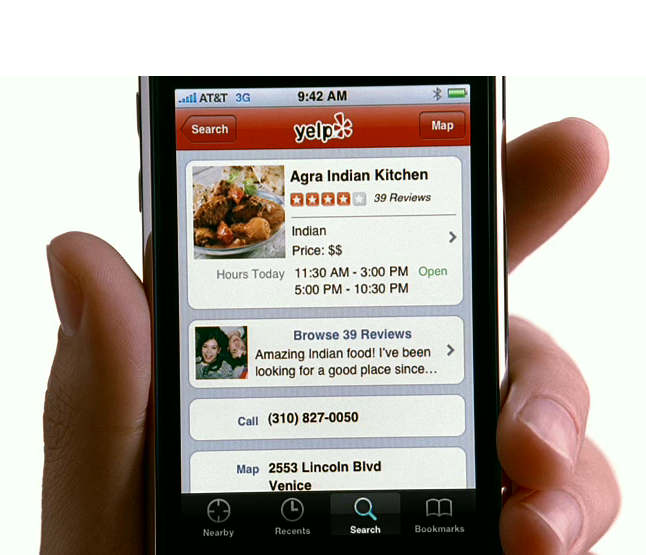
According to an image provided by AdAge, the display ads will appear just as one would expect. Below the options tabs in a company’s page on Yelp, and just above Review Highlights, a standard mobile banner will appear, allowing companies to place their display content smack in the center of what users are viewing.

There are many business marketers out there that dread the things that occur on Yelp that are out of their control. Now, businesses have at least a slight chance to use Yelp to their advantage, granted people don’t see the bad reviews before seeing the banner ads.

Pandora Falls on Hard Times, Limits Users

Consumers are spending more time than ever on the web these days, and one of the main reasons they use the internet today is for listening to music. In the music world, commercial success can no longer be measured by the number of albums sold in a career. Musicians measure their success now in online plays, shares, and streaming numbers. Of course, there are the numbers of tickets sold at concerts and shows, but for the most part people are listening to the top hits on the web. Marketers know this, and many have tapped into the marketing opportunities that music streaming platforms have to offer. Pandora, arguably the biggest name in online music streaming, has offered a lot to advertisers over the past few years, but it seems it has not been enough. According to a recent blog post from Pandora founder Tim Westergren, Pandora has fallen on hard times, and actions are being taken.

The blog post was created in order to announce that Pandora is now introducing a 40 hour limit each month for free mobile listeners. As one would expect, this decision was made primarily to create more paying subscribers and reduce the number of heavy free mobile users.

Now, Pandora is not simply trying to make more money for no reason, but it seems royalty costs are on the rise. Pandora’s original expectation was that they would be able to cover loyalty costs with advertising revenue, but there simply is not enough revenue coming in from advertising to match the high frequency with which heavy mobile Pandora listeners are streaming music.

Over the last three years, loyalty costs have gone up over 25 percent, 9 percent in 2013 alone. Furthermore, these loyalty costs are expected to rise over 16 percent more in two years’ time. However, this is not as devastating as it may sound, and Westergren gives us the facts to support that.

Most of you reading this will never hit the limit. In fact, it will affect less than 4% of our total monthly active listeners. For perspective, the average listener spends approximately 20 hours listening to Pandora across all devices in any given month.

That said, limiting listening is a very unusual thing to do, and very contrary to our mission so we wanted to share a quick explanation.

Although music sharing and streaming with applications such as Pandora are incredibly popular these days, the simple fact is that people stopped feeling the need to pay for music back around the turn of the millennium. It is because of that fact that the advertising that Pandora thought would keep it in the clear financially simply is not cutting it. Westergren did not mention anything about what this could mean for marketers, but it can really only go one of two ways. Either Pandora’s advertising costs will go up, or the company will not be able to offer as much advertising opportunity, as more customers subscribe for the ad-free version of the service.

To be clear, this is only for the mobile version of the service, as it is the primary platform for Pandora listening.

Social Gaming Ads Out-Perform

Browsing the Facebook News Feed is all well and good, but there is only a certain level of excitement that comes from doing so. Because of this, a long time ago game developers came up with the idea of making a new type of game; the social game. Social games provided more for the everyday user to do on social sites, and it created a whole new area for advertisers to focus on. Social games have since become something beyond a Facebook accessory, and social gaming is an everyday activity that internet and mobile users do not have to visit Facebook to do. With the growth of social gaming came a growth of social game advertising, and it seems that advertising within a social game has become quite a successful practice.

In a report released today from MediaBrix, we can see that advertising in social and mobile gaming has surpassed numerous other forms of online advertising in terms of performance. The report shows higher rates of engagement as well as higher clickthrough rates for these social and mobile gaming ads than many other types of ads. This information comes from a comparison of the performance numbers for social gaming advertisements found by MediaBrix to online video and standard online advertising benchmarks from eMarketer.

Social Gaming CTRs

According to the report, the average clickthrough rate generated by social and mobile gaming ads was around 3 percent. This number is 30 times the clickthrough of the everyday banner ad, which eMarketer states as being 0.10 percent. Not only that, but it is also somewhere around 30 times higher than Facebook ads and rich media banner ads, which have clickthrough rates of 0.03-0.11 percent and 0.12 percent respectively. However, what makes social gaming more significant is that it introduces the possibility of rewarding consumers upon their viewing of an ad. This method brings in an average clickthrough rate of 11 percent, which is far greater than the rates of other, more widely used ad types.

Higher Engagment and Completions Too

Social gaming ads have a hold on these performance categories as well, boasting average engagement rates of 20 percent. In comparison, pre-roll ads have engagement rates of 0.7 to 3.64 percent, and Facebook Page ads have average engagement rates of only 0.5 percent. As for completions of video advertisements, which are a popular option among social gaming advertisers, social gaming video ads have an average completion rate of 91 percent. This is only dominated by ads viewed within full episodes of TV shows online, which have completion rates of 93 percent. However, other video ads have significantly lower completion rates;

  • Ads on video portals: 84 percent
  • Ads on news sites: 83 percent
  • Ads on news outlets: 73 percent

Social games are an advertising platform that is rarely talked about, although it seems that ads within these social games are performing considerably better than other, more traditional ad types.

Social and mobile gaming campaigns are able to provide engagement levels and benefits that far exceed what standard online advertising can offer brands. Thus, social and mobile gaming ads continue to gain traction amongst marketers.

Facebook Buys Atlas from Microsoft

When Facebook actually began being considered a viable advertising source, there was a lot of speculation and criticism being thrown at the company. It may be a direct result of this criticism that Facebook takes such huge strides in the way of helping its marketers in any way that it can. Of course, there are still those people out there that still doubt the merit of Facebook in the advertising world, still believing strongly that Facebook ads simply do not work. So, Facebook continues its quest to prove that their advertising offerings do work, and that marketers can be successful using the number one social network to get the word out. Yesterday, Ad Age reported their expectations that Facebook would today purchase Atlas, an online ad measuring and serving service, from Microsoft. Today, their predictions came true, and Facebook has acquired the service.

Facebook’s director of product marketing Brian Boland says quite a bit in his Facebook Newsroom post, announcing the company’s acquisition of Atlas. However, through all of the benefits and facts stated in the post, one can tell that the real reason for Facebook’s acquisition of Atlas is to stop the criticisms I mentioned above. The company is trying to give marketers the proof that says Facebook ads work, which they apparently still need. Although, this is simply a theory. Here is what Boland actually states as the idea behind acquiring Atlas;

If marketers and agencies can get a holistic view of campaign performance, they will be able to do a much better job of making sure the right messages get in front of the right people at the right time. Atlas has built capabilities that allow for this kind of measurement, and enhancing these systems will give marketers a deeper understanding of effectiveness and lead to better digital advertising experiences for consumers.

There are some people out there that have the idea in their heads that Facebook has acquired Atlas as a way to better compete with Google, or even to imitate some of their moves. There is a theory that Facebook may have plans of spreading Facebook advertising across the web, as Google has done with AdSense. However, it seems the more accepted reasoning is simply to give marketers accurate measurements of ROI, essentially proving the success that Facebook Ads can bring in.

As for the actual purchase itself, there was no price released for this huge sale, but of course that has not stopped anyone from making educated guesses. The general consensus on the subject is that the price was probably between $20 million and $50 million, but definitely not higher than $100 million.

Facebook has done a lot of work with companies that measure the web’s most successful advertising providers, trying to prove its worth to the public. With Atlas on its side, maybe the company will be able to put a stop to a chunk of the doubt it receives.

 We look forward to further building out the Atlas platform to help marketers better understand how well their campaigns perform, and to help them optimize their campaigns.

We look forward to welcoming the Atlas team.

FTC Sues Cresta Pillsbury & JP Diaz

Not sure anyone still works with Superior Affiliate Management aka Ecommerce Merchants, or even if they are even in business anymore., but there is some bad news for the owners and employees of the company by way of the FTC. According to the FTC, they have gone after Cresta Pillsbury, Jan-Paul Diaz, Joshua Brewser and Daniel Stanitski for among other things sending 30 million unsolicited commercial text messages.

This is really bad news for TrustGuard, another company Ms. Pillsbury is associated with, that has recently been promoting itself as a compliance and security company for merchants. A press release quotes her as saying, “We look forward to helping e-Business Express’s customers navigate the compliance validation process so they can increase sales and reduce liabilities.” I’m sure the FTC isn’

There isn’t much news about this yet, but expect to hear additional information from the FTC in the next week.