Your Traffic Sucks… Go Indian

So a few night ago I was buying an energy drink at a place we all know and hate..Wal-mart.

Like usual the lines were backed up with a ton people and  I was going have to wait in line for a good 20 minutes just to buy 1 drink. This was a waste of time, and one of my biggest rules is Value Thy Time.

So, I instead walked 10 steps over to the electronics departments cash register and was able to check out in seconds while the horde of people continued to waste their lives waiting in line for one of the many open cash registers in the store.

The funny this is this is that 95% of marketers have something in common with these people.  Instead of a fighting over the same cash register though , marketers are dueling over the same traffic when the cold hard truth is THEY DO NOT HAVE TO.

Just like at Wal-Mart, there are cash registers (traffic) everywhere. However most  online Marketers, just like the Wal-mart people,  are stuck fighting over just 1 type of traffic.

American Traffic Is The Hard Way

Alright, did you know that well over a billion people speak English? Did you also know that only 300 million of those people live in U.S? That is not even half of the english speakers in the world.

So what is really crazy, is that most of marketers target only 30% of their potential English speaking customers (Americans)

The result is there being WAY to much demand for American Traffic and way to little supply of it. Because of this

  • Ranking highly in the American Google(.com) is extremely competitive
  • The price for advertising to American traffic  is astronomical
  • You constantly have to fight your competition to stay on top

In short, marketing to American traffic is like going to overused playground covered in broken glass and expecting to have fun.

So who do I market to then?

The answer is foreign countries!

  • Guess what massive country speaks mostly English and is exploding right now..India
  • Canada’s first language is English, yet its is almost 10 times less competitive for online marketing
  • The Google Adsense CPC for some completely untapped high traffic keywords in the Philippines (speaks mostly English) is over .90 cents

The thing is this applies to  applies to all sorts of traffic generation online methods (SEO, paid traffic, etc) Check out the example below ( based on real results I have gotten online)

For Paid Traffic In The Same Niche

Price for 150×150 banner ad on an American site = $2 per CPM (thousand views)

Vs

Price for a leaderboard sized Banner on a Canadian site = .02 cents per CPM (My cost per click was less than .01 cents)

Best of all results like this are very common. Here so other benefits to target foreign traffic

-The price for Pay Per View traffic is often 4 times cheapers from foreign countries.

-Adspace can be bought for next to nothing.

-Searchs that are extremely competitive in the Amercian Google are virtually open game in other countries ( I get into this a lot in another popular article of mine : The Harsh Truths SEO and How The Big Dogs Really Bank ).

There is literally an endless amount of loops holes when you start looking at traffic globabally instead of just focusing on one spot.

AND The reason for this is not because the traffic is bad, it is simply because no one is fighting over it yet!

So Stop Waiting In Line

If you are an online marketer, stop being one of the 100 morons waiting in line at Wal Mart and be the guy that finds the better way to do things.  One of the coolest things about the internet is it allows you to get access to customers regardless of where they live. Restricting yourself to just one country is absurd!

Stop fighting over high priced competitive traffic and start utilizing the untapped foreign traffic that will literally bring you the SAME results for 1/10th of the work.


Five Tips to PPC Success

Ever run around your house destroying everything in your path in a huge panic looking for your keys, phone, etc? As you frantically search every corner imaginable you may have even accused your kids, significant other or anyone in the general vicinity of misplacing it only to find that the item was right under your nose the whole time. Well, if you have had this experience or something similar then maybe you can relate to the topic of discussion on today’s agenda.

In my profession I am often given the opportunity to work closely with many PPC marketers who share with me their experiences, both good and bad. Just recently, I spoke with an advertiser who stated that he was on the verge of ending all of his PPC advertising efforts due to what he believed was bad traffic quality. He said he didn’t want to continue spending money only to see little to no return. The more we discussed his concerns I began to realize that he felt this to be true about many of the paid search engines he had been using to promote his website. When you consider the odds of 3-5 search engines all delivering sub-standard traffic to one specific advertiser, it doesn’t seem to be a very likely occurrence. I am, however; inclined to agree that it is possible for maybe one or two out of five search engines to deliver consistently bad traffic quality. In the case of this advertiser, I would still question why he has not seen better results from at least two or three of the search engines he has tried.

Much like the scenario referenced at the beginning of this article, the solution to most PPC conversion problems is often pretty obvious yet the most overlooked. Many advertisers spend so much time blaming their inability to convert on poor traffic quality that they never even stop to consider the possibility that the problem just may be IN-HOUSE. By in-house I am referring to their own website. Even if it receives the highest quality traffic, a website with a list of unflattering issues will still find it hard to see any real success. Here is a list of the top 5 reasons why many websites fail to reach pay-per-click marketing success:

1. Slow loading pages– Who has all day to wait for your site to load? Not I, and neither do most of your visitors. People are impatient so even if you get a ton of clicks on your ad it won’t do you a bit of good if most of them abandon the site before the landing page is even done loading, so get the lead out!

2. Appearance – Make it easy on the eyes. Super bright text colors and funky font sizes simply scream amateur. Random, irrelevant images and sparse content can drive a potential sale right out the door. Keep it clear, concise and consistent.

3. Deliver as advertised– Let’s see, your ad says you offer the wonder widgets in blue, now that you have a visitor on your site ready to buy them, they are out of stock! Big no-no. Never mislead web surfers into clicking your ad only to have them arrive and not find what they thought you could provide. Can you say “a waste of their time and your money”?

4. Market awareness– Why does the same product or service cost so much LESS on other sites than it does on yours? In this economy, the higher pricing strategy is definitely a bad idea. It’s a great idea to make sure your pricing is just as appealing or more than your competitors.

5. Functionality – How can people sign-up for your service or buy your product if your site doesn’t function properly? Links that lead to nowhere or redirect to unwanted places are almost guaranteed to give your visitors the wrong impression. This is a simple fix that can definitely have a positive impact on your bottom line.

The point is clear. Before simply assuming your ad is not converting as a result of bad traffic quality, consider the possibility that the problem may be even closer than you may think.

Brought to you by 7Search Looking for a new traffic source? You must try 7Search!

8 Facebook Marketing Hacks You Should Try RIGHT NOW

So you want to learn a few marketing tips on Facebook, huh? Well, I’ll give you SEVERAL! As internet marketers, we have to be tricky and cunning with how we reach our audience. With Facebook always changing its layout and features, it’s pretty hard to keep up. Aaaaaaaaannnnnd, that’s why I’m here.

So here are the eight Facebook tips you should try RIGHT NOW.

Tag Your Friends in Status Updates

Do you have a link, video or message for your latest product? Post that link, video or message as a status update and cleverly integrate your friend’s name. The two key words here is “cleverly integrate.” Don’t make it so obvious that your friends will make it their mission to defriend you. Do this too much and you’ll be reported for spam.

Hint: Use the @ symbol followed by your friend’s name in your status. This will tag them.

Creative LoafingBecause he remembered I like Jazz, Joran told me about a Half-Off deal on a jazz club that just reopened. 

Tag Your Friends in Photos

If you have some very influential friend, this is a sure-fire winner. But if you don’t, it still works to get your brand some recognition. Whatever the picture is even if it’s not for your brand, remember not to tag them in embarrassing or compromising situations…this can be detrimental to your friendship.

Upload a photo with your brand. Add a description to promote the brand. Tag as many friends as you can in that one photo.

Not only would their names show up on your picture, but it will pop up on your friends’ profiles for all of their friends to see…that is, if they didn’t disable the public showing of their tagged photos. Even if this is the case, your friends will get notification that they’ve been tagged and of course will open it up to check out what the image is.

Missy WardMissy Ward & Clicky at Affiliate Summit West 2011 

Tag Your Friends in Notes

This is especially useful if you have a blog. What you can do is import your blog posts into Facebook so that they show up as Notes. Once the blog posts make their successful transfer, go and tag away! But remember to not be a constant tagger or you’ll be a constant spammer.


Comment on Your Friends’ Walls

What good are you as a friend if you don’t interact with your people? Write on their walls. Pop in every so often just to say hi and see how they’re doing. “You’re confronting the question of ‘Why is this person even in my network in the first place?’ with a logical answer. You’re reaching out. That’s pure networking,” says Peter Shankman, PR and Social Media Power Player.

Shankman’s blog post, Unfriend, Write or Die, is a must-read on this subject.

This approach is not necessarily a hack, but it is a way for you to stay in the front of your friends’ minds.

Comment on Group, Fan Page and Event Walls

Target your niche. Join groups, fan pages and events that are associated with your line of work as well as your products. Once you do that, promote your product/brand by leaving comments on its walls.

You can “kill two birds with one stone” without having to leave your homepage. Same thing with tagging friends’ names in status updates, you can tag the group, page or event by using the @ symbol before the word. It’ll not only appear on your profile, news feed and friends’ news feed, but it will also show up on the page that you tagged. Bada Bing!!!


Ad TechClickbooth’s Fan Page 
Ad TechAd:Tech’s Fan Page 

Like Status Updates on Friend, Fan Page and Group Walls

Here you can do one of two things. 1) You can like status updates by using your personal profile account or 2) you can create one for your brand and use that. By liking from your personal profile account, you are letting your friends know you care what they have to say. Creating a company profile or Page (Facebook has recently launched this feature to let you like a status as your page), you are now promoting your brand.

OffervaultGood one, Guys. 

Create a Group Page and Add, Add, Add

Facebook also allows you to add friends to groups without needing their permission. This is a very easy way to give your brand exposure and really quickly.

Back in October 2010, someone by the name of Jon Fisher totally owned Mark Zuckerberg, CEO of Facebook, and Michael Arrington, Founder of TechCrunch, with this feature. He added “Zuck” and Arrington to a group called NAMBLA, a man-boy love group, without their permission. It created a pretty big ruckus about Facebook privacy. Eh, what’s new? Could this be THE Jon Fisher I know from WickedFire? You tell me.

So to follow Fisher’s footsteps, all you have to do to create the group is come up with a name, write some content and add all of your friends. The only way they can say no to the group is if it sucks. What is the first rule in business? Don’t Suck!

Create an Event and Invite, Invite, Invite

Create an event where you can invite all of your friends. Same thing as creating a group page. Think of a good event name. Get some content in there. Invite. My favorite attribute about this hack is that you can message everyone you’ve invited (even people who haven’t responded) and have it pop up in their message inbox. Suh-weet!

—–

Thao Tran is the Head of Social Media at Clickbooth.com

Learn also about this Crazy Affiliate Marketing Technique


Top 10 Reasons Why You Shouldn’t Exhibit at an Affiliate Marketing Conference

Exhibiting at a trade show can be costly, but for the world of me, I fail to understand what most companies are thinking when they bring a whole team or hire temporary “booth babes” but have absolutely no clue or a game plan what they want to accomplish. Without proper and effective training, some booth staffers may not realize how some inadvertent actions can impact an organizations reputation and potential business. Below is a Top 10 list to keep in mind before the next show.

Top 10 Reasons Why You Shouldn’t Exhibit at an Affiliate Marketing Conference

1 ) If you “ran out” of business cards on Day 1.  Time and time again I constantly hear, “Oh I am sorry, I ran out of business cards.” Really? You spend all this time and money and forget something so simple but critically important?

2 ) If the first words out of your mouth are, “Where are the parties tonight?”  While parties are a great venue to network and drum up some business, it should not be your sole motivation to attend.

3) If you find texting more exciting than the people waiting for you at your booth.  You can’t begin to imagine how many booths I visited at the Ad-tech and what % of the employees were on their phones texting. Forget the employees; I saw numerous C-level execs doing the same.

4 ) If you prefer talking on the phone while people are waiting for you at your booth.  See comments to bullet 3 above.

5 ) If you prefer eating while people are waiting for you at your booth.  We all get hungry while manning the booth – but schedule a time with your team where you get a break and go eat in a designated area.

6 ) If you prefer “passing” the card to someone not present to follow up.  This is a favorite of mine. I am at your booth, ready to give you some business but what do I hear, “email us at affiliateservices@mycompanydoesnthavethetimetotalknowandwearewaytoobusytexting.com and we will have one of our dedicated reps contact you.”

7 ) If you prefer talking to your neighbor more so then potential customers.  See point 3 above.

8 ) If you are late to your meeting appointment.  We have numerous meetings lined up at these shows and often times they run a bit longer than expects – and that is perfectly fine. But extend the courtesy of emailing, calling or texting the next appointment that you are running a bit late and let them know.

9 ) If you are more concerned about giving your pitch rather than taking the time to find out my needs.  Often times I hear companies ramble on and on about how great they are but not for a sec take a moment and ask what it is that I truly want.

10 ) If I know more about your company than YOU do.  This has to be my all time favorite. Most of the staffers have absolutely no clue what their company truly does, what their benefits are relative to their competition, how they can help me achieve my goals. If you are going to be at a booth – take the time to learn some basic concepts such as (I am sure they may be difficult for some of you): CPA, CPL, CPS, Affiliate Marketing, PPC, SEO, PPV, Co-reg, etc. See where I am going with this?

—–
Ricky Ahuja is the CEO of Affiliate Venture Group

Five Money Making Trends in Affiliate Marketing

ADOTAS – As a publicist working predominantly in the online advertising space, a good indication I get regarding what’s happening in the industry is from the new business prospects that come my way. First of all, good things are happening in the industry, based on the quantity of leads my peers and I are receiving. Beyond this, one trend that is clearly growing is affiliate marketing.

A decade ago, the affiliate marketing industry had a reputation of being the response-based, sales-driven, “non-creative” end of the online advertising world. But as more and more established brand marketers embrace affiliate marketing, the industry’s reputation (and share of the ad budget) has improved. Add to this all of the niche-based ad opportunities which social media and the blogosphere have provided for affiliate-based advertising – where affiliate-based ads for a fast moving consumer goods products make perfect sense on a Mommy blog – and you have an industry that is gaining strength.

And here are a few trends which are contributing to the growth of affiliate marketing:

1. The rise of social networking functionality like Facebook’s new Sponsored Stories, which enable an advertiser to sponsor a users ‘Like’ OR check-in, are basically turning all of us into affiliate marketers for the brands which choose to support. Couple that with the growth of Word-of-Mouth marketing, and we’re starting to experience a new and more personalized form affiliate marketing, not unlike one envisioned by Heather Locklear in this commercial for Faberge Organics commercial from the 1980s.

2. The increased acceptance of activity-based compensation, including revenue share deals and cost per action, has made it more acceptable to work with affiliate marketers who work almost exclusively with activity-based compensation.

3. Affiliate marketing is sometimes referred to as performance marketing. After 2009, who doesn’t want a campaign that can be monitored and measured on a performance basis (well, accept for the creative director)?

4. A final trend I’m seeing which is impacting affiliate marketing is re-targeting. With re-targeting all about converting shoppers who previously visited a website, arming affiliates with the ability to retarget was a logical conclusion. Today, companies like myThings (disclosure: myThings is a client) are bringing affiliate marketing to affiliate networks and their affiliates (publishers) and merchants (advertisers).

This isn’t the death of the 30-second TV commercial (or the Internet banner ad), but affiliate marketing tactics are going to be implemented more and more in online (and offline) advertising campaigns.

—–

Uriah Av-Ron works for Oasis PR and is based in Tel Aviv, Israel.

Ahuja Means Make Money in Punjabi

You don’t see that many Sikh’s in affiliate marketing. Honestly, you don’t really see that many Sikhs in general, especially where I moved to, Colorado which is the Capital of the Secret WASP Society.  That being said, Ricky Ahuja has made a name for himself in this industry. Ask anyone and they will tell you that he is a very friendly, outgoing person who treats everyone with respect – something that this industry often needs.  Anywho, he’s also a great businessman who has made a good name for himself in this industry as someone who pays attention to what is going on in the industry and is always networking to learn more.

How do you personally get into Affiliate Marketing?
I have been in the space since 2001, started with a loyalty site, on to web design, seo and other lead gen businesses. The tools have changed quite a bit – but at the core it is still the same. Like every other venture, has its ups and downs but love the dynamic nature of it.

What makes Affiliate Venture Group unique and interesting?
AVG like every other network has some offers and some publishers. However, what sets us apart from most of the others is our level of access, transparency and communication. We are definitely not in it to make a quick buck as reputation to me has more value than anything else. I think we have done a good job of maintaining that.

What does Affiliate Venture Group look for in its affiliates?
Transparency, communication and honesty are probably the most important traits we look at. We do not turn away any newbies and take the time to inform and educate them best we can. Had it not been for a helpful AM back in the day, I would not have been in the space as long as I have. We are more about the person behind the affiliate cloak and their word. Take undue advantage of it, we will not be working together in the future. Work with us and you would have found a valuable resource for a long time to come.

What is the most common fraud you’ve found in the industry, and what steps does AVG take to combat that?
We have come across fraud such as use of stolen credit cards to generate leads, posting of leads, fake clicks and referrals, etc. Our core philosophy of maintaining clear lines of communication and transparency have helped greatly in combating this. We can all build tools to counteract this – but the fraudsters always manage to stay one step ahead. Having groups on the social media sites certainly help bring the issue to the forefront but we always have to remain vigilant and proactive to contain/prevent it.

You had an Affiliate Fraud Group on Facebook that was shut down, what happened? Who served you with the C&D?
We had a very promising group called the Affiliate Fraud Prevention Group with over 1400 members which was served a C&D and thus had to pull it down. Not really able to go into too many details but AVG was in its infancy stage and were somewhat blindsided and not prepared. We obviously weren’t alone as other unsuspecting networks experienced the same issues. In a weird way however, that was a good lesson for us in opening up our campaigns for publishers we were not 100% familiar with and enabled us to put certain policies and protection in place.

What he can’t tell you is that he was threatened by “IAG” a company in Florida, that was accused of not paying their bills on the Facebook group.

If you could have any wish, what tool would you like seen made for affiliates?
We work very closely with the developers of our tracking system in identifying various touch points which we feel may lend to fraudulent affiliates coming in and work towards establishing tools to counteract that. Above and beyond that my partner, Chris Kautz,  has often been called The Affiliate Slayer as he has a keen sense of weeding out the bogus pubs. One thing I would like to intimate however, for every fraudulent publisher – I can tell you one advertiser and/or a network that partakes in this same vicious practice. This is a two way street and quite honestly both sides can be at fault. This is precisely why we only work with a handful of partners on both side and that formula has worked out well for us.

What ideally would you like to teach brands about affiliate marketing?
We work with several premier brands, both on the Affiliate Venture Group side as well as the agency side of the business, Pab67Media and fortunately for us, more and more are starting to understand the true value of affiliate marketing. There are instances when however the “brands” are not set up logistically or technically to handle the traffic/sales generated or more importantly, what is converting and what is not and there is where problems typically occur.

Who is the sexiest affiliate manager that you’ve met?
I am going to have to say my wife – she plays a role of a physician by day and by night – she is Super AM. Totally keeps me on top of things and my main driving force (along with my 8 year old daughter). I feel this is the safest answer for me.

Internet Marketing Dwarfs Its Predecessors

Gone are the days of desperately probing through the yellow pages in the middle of the night, searching for a plumber in close proximity, to resolve an unexpected blockage of inconvenient proportions, only to find that their printed number is no longer in service.  Times have changed.

The digital Goliath now reigns supreme and brings with it up-to-date, instant information in the form of Internet marketing. Information is now accessible from anywhere and at any time. It dwarfs traditional marketing, making it an ink spot on dated piece of paper.

Advertising is the backbone of any successful business, regardless of size. Effective advertising is measured by the amount of business generated from a specific marketing campaign. Companies across the board are finding that nontraditional forms of marketing, such as search engine optimization (SEO), pay-per-click advertising (PPC) and online videos are showing fast, effective results. These companies are using innovative methods to develop outstanding market repertoires.

Finebloom and Haenel is a Florida-based DUI law firm. In March 2010, the firm hired my company Everspark Interactive, an Atlanta-based SEO agency, to create a digital marketing campaign for their business. Within nine months, the firm has seen a 35% increase in business.

“This SEO marketing campaign has done amazing things for us,” said David Haenel, co-founder of Finebloom and Haenel. “The phone rings more and we have been on the first page of Google repeatedly from keyword searches.”

SEO marketing campaigns ensure that businesses make a unique impression to connect with consumers. Unlike traditional marketing, Internet marketing focuses on each business’ unique characteristics and promotes those characteristics to a target audience.

With the prominent shift from print to the internet, more consumers rely on digital sources for information. This information is global, and readily accessible through the use of computers and smartphones. Haenel predicts that businesses who continue to rely on traditional marketing, will soon struggle for survival.

“If you don’t use nontraditional marketing methods, you are going to get crushed,” Haenel warned.

He added that his firm will continue their SEO campaign into 2011, by adding mobile sites to their website, so that clients can access the firm’s information from their smartphones.

Benefits of nontraditional marketing:

1. Internet Marketing is More Measurable

Companies can effectively track marketing spending, as well as track the results of any Internet marketing campaign. Traditional marketing is based on a principle of trust, nontraditional marketing focuses on measurable results.

2. Internet Marketing Makes Strategic Decisions Based on Facts

Based on measurable results, Internet marketing can modify a campaign instantly to adjust to the public’s response. It can base those decisions on detailed analytics. Consumer response can be studied in detail and in real time.

3. Internet Marketing Effectively Reaches a Target Audience

Internet marketing can target an audience of any size and location through SEO tools. In contrast, traditional marketing focuses on a mass audience through magazines or television advertisements

4. Internet Marketing is a Constant Source

Internet marketing is ever-present. A Web address remains in the same spot, all the time. Consumers can find business services by doing keyword searches. In contrast, traditional marketing depends on allotted time-slots or print space to convey a message. If the consumer misses a television commercial, the business lost a potential client. Internet marketing is constant.

5. Internet Marketing Provides Better Word-of-Mouth

Social media sparks conversations that can reach an audience of massive proportions, within minutes. Word-of-mouth remains the most effective form of marketing and client growth.

6. Internet Marketing Increases Conversions

Internet marketing gives businesses the opportunity to track the effectiveness of the marketing campaign. They show which strategies work, and which don’t. This ensures a constant increase in conversions. By contrast, traditional marketing simply creates a campaign and relies on hope as its strategy for success. Internet marketing offers an up-to-date, accurate representation of results, which a business can choose to drop or develop to ensure the best possible outcome of their campaign.

—–

As the director of SEO at Everspark Interactive, Jason Hennessey oversees search marketing campaigns for high profile celebrities, lawyers, politicians and Fortune 500 companies. Within the industry he is known as “The Secret Weapon” people call on when they want to rank for extremely competitive terms in short periods of time. Hennessey has played an instrumental role in turning Everspark Interactive into a $1.2 million agency in only three months.

Is Article Marketing Dead?

In recent days, there has been a virtual maelstrom of outcry and heated opinions on Google’s recent algorithm “shift”. Nowhere else has this controversy manifested itself more than in the article marketing space.

In January, EzineArticles, the largest, and still most authoritative article directory online, cracked the coveted 100 most popular web sites in the world, serving 57 million unique visitors that month. Then, striking with the suddenness of a vicious lightning bolt, on Thursday, February 24, Chris Knight, CEO of EzineArticles, confirmed they lost 11.5% of their traffic and the following day, Friday, another 35% of their traffic vanished.

Later the same night, Chris made a blog post at EzineArticles saying that next month (March 2011, that is) their traffic may fall to half the levels it achieved in January.

What is going on? Does this sudden, swift, and dramatic decline signal the death knell for article marketers everywhere? Especially those that have come to rely on EZA primarily as the vehicle to deliver that laser targeted search engine traffic to their web sites?

Opinions are heated and varied. On EzineArticles’ blog, as of this writing, Chris’s post has garnered over 250 responses. Similar heated debates are popping up on the Warrior Forum, and, of course, AssociatePrograms.com’s own Brad Hauck discussed the duplicate content issue with respect to article directories such as EZA in the most recent newsletter.

After running an affiliate training service for almost 3 years that revolves around article marketing, and living and breathing the space, my answer to the questions posed above is both yes and no – that is, some article marketers are in for a rude awakening, while I smell opportunity for others.

Let me explain.

Chris Knight on his blog post mentioned various ways EZA intends to tighten up their rules even further. Here’s the crux of his argument: “We’ve been both quietly and publicly at war with a small percentage of our membership who aim to use our site to game the search engines with what we refer to as ‘article vomit’ or thinly-crafted software-spun articles.”

EZA will now spend more time on quality checks – format, grammar, spelling, and consistency – and has increased word counts to 400 words minimum for acceptance. Other possible actions include requiring articles submitted to them to be unique only to them (no longer allowing the same article to be submitted to various article directories), and more.

On Saturday, after I had time to read the various threads, Chris’s comments, EZA’s possible impending changes, I then performed a thorough review of the traffic being generated by members of my article marketing training service.

The good news is we, as a group, were not negatively impacted even though article marketing is the traffic source we most rely on to generate affiliate sales.

The real question is: Why?

The short answer is we keep things “legit” and “real.” It doesn’t matter if you’re in my training service or not. If you want to persevere and prosper with your online affiliate endeavors, I believe the same lessons will apply to you.

For example, from the outset, I have always advocated my members do the research for the industries and products we are promoting and learn to write the articles themselves under our guidance. Anyone in my service will vouch for the fact that I have always severely cautioned against using article spinners, and PLR services.

Well researched, authentic, meaty content
As a result, our members overwhelmingly produce well researched, meaty, authentic content in the niches we target, providing real value to people who come across those articles. In fact, one of the long standing perks of my service is that I personally review the first few articles students write to give them feedback on how to improve their writing – or point out things they are doing wrong.

As a corollary, because our articles tend to be highly informative, it’s with very rare exception that members of my service ever write articles under 400 words as well, thereby already protecting them from “sweeps” of thin content articles that EZA is already in the process of implementing.

Because I also foresaw some potential issues with duplicate content penalty, several months back I also initiated a preemptive protective action in my service to allow any member (new or longstanding) to obtain unique, original copy for their affiliate presell web site so that no two students would have duplicate content that appears on their sites.

In addition, about half of our members build their own presell web sites, and, as a whole, do a fantastic job of keeping their content original because it’s in alignment with the way we teach and do our article marketing – we don’t believe in or advocate derivative material. On this latest Google shift, I checked out some of their web sites and noticed their results were still strong, often claiming top rankings for desirable keywords.

Bad news for some affiliatesN
ow, the bad news. If you were the type of article marketer who was churning out hundreds, if not thousands, of short (250-300) word articles quickly, and using article spinners, and PLR services, your days are undoubtedly numbered. In fact, in the days ahead, it’s likely you’ll see most of your articles wiped clean out of EZA directory, if it hasn’t happened already.

However, if you target true evergreen products, do real research, and keep your content valuable, you’re actually going to find the latest changes to your benefit in the fullness of time. As the thin content article marketers get cleaned out, I strongly believe the result will be less competition for not only members of my service but legitimate article marketers everywhere.

In addition, EZA may also be reducing the number of Google AdSense ads they serve on pages of their site as well. If they do, this should translate into an even higher click-through for legitimate article marketers who stick it out because probably the biggest diverting factor from getting the readers over to your presell site was losing them to a Google AdSense ad served on EZA’s site itself. Of course, this is how EZA keeps their service free, but it’s still worth pointing out this potential upside to us article marketers beginning in the near future.

Recommended changes
Having said all of this, I am advocating certain changes to my members (and to all of you). First, I believe you should write only unique content for each article directory. If you write an article for EZA, that article should not be submitted to other article directories, and vice versa. EZA may or may not implement this rule, but I think you should be doing it anyway.

Moreover, whereas I used to think it was OK for someone to add articles they’ve written and own to their own web sites or blogs, I no longer advocate this. Perhaps I am being paranoid, but you never know just how far Google is going to go with the “duplicate content” thing. I suggest that members now keep their article marketing content unique and different from the content that they create on their blogs and/or presells.

Lastly, I think the days of “bum marketing” are coming to a close. “Bum marketers,” as near as I could tell, tended to focus on fad products. They did some quick, superficial research, blasted some article marketing to those fad products using thin content for a while, then rinsed and repeated the process for the next hot product of the month. Indeed, on EZA’s blog post on this issue, they mentioned that sweeps of certain areas have already happened, acai berry being one example they listed – and which also happens to represent a perfect example of a fad product.

Bum marketers, by their nature of constantly jumping around and promoting new things, never really develop deep knowledge in the niches on which they are writing. They also almost never use the products they are promoting, either, and this clearly shows in the content they create. By contrast, a significant portion of the members in my training service, through the knowledge they acquire, come to believe passionately in the products we promote and end up as consumers themselves, which, in turn, creates a genuine experience and furthers their knowledge, which manifests itself in their content.

In conclusion, life throws us all numerous challenges. It’s always how we react to circumstances, even if we cannot control them, that counts in the end. Of course, it’s always helpful to be keenly cognizant of potential issues before they crop up and nip them in the bud.

I believe one reason for our enduring success as an affiliate training service is because we have tried to anticipate potential issues before they have arisen, just as you must, and taken action accordingly. Of course, I’m also quite certain we’ll face issues in the future we had not anticipated, but our resolve will be to solve those problems when and if they arise.

The ability to adapt to change is one of the hallmarks of leading a successful and productive life, and in the Internet marketing space, change happens much quicker than it does in many other fields. If you expect to endure as an affiliate marketer for the long term, as I have for 9 years now on a full-time basis, you must always stick to creating content and promoting products worthy of longevity. Attempting to make the “fast buck” today may mean making no bucks later, whereas building a proper foundation, even if it’s a bit slower out of the gate, may mean a passive income that sets you free in the years ahead.

—–
Dan Ho is a super affiliate and the founder of AffiliateArticleWriters.com, a training service to build lifetime & passive income.

Amazing new Affiliate Tool Check it Out!

The Four Pillars of Building Trust to Increase Conversions

Human beings are social creatures that seek out companionship and relationships. Our map of reality can be viewed as a series of concentric circles which include the most trusted relationships and those who are in our hearts at the very center.

We crave trust. Without it, we would be consigned to a world where we must examine everyone’s actions with suspicion and assume that they are working only for their purposes and not ours. Because of the sheer number of social interactions that we have with complete strangers, we must at least extend some trust.  Otherwise many acts, both small and momentous, simply could not happen at all.

Even with total strangers in the “real world” we at least have their appearance and body language to go by. But what do you do online? Almost anyone can quickly create a website or landing page and masquerade as a wide variety of businesses. Many of these enterprises are untrustworthy. We are often barraged in the media about various scams perpetrated online and have our guard up.

As an online marketer, your job is very difficult compared to your bricks-and-mortar marketing counterpart. You must not only overcome anxieties, but do so in the most challenging of circumstances.

Online trust must be developed without any face-to-face contact, and it must be created instantly in the few precious seconds it takes a website visitor to evaluate your value proposition.

So how can you build instant trust online?

The following pillars of trust can be employed with great effectiveness.

Appearance

First impressions matter. We do judge a book by its cover. Recent research indicates that people will form an initial impression of your landing page or website within fifty milliseconds. This is almost as fast as visual processing happens in the brain, and can be considered as an instantaneous and automatic response. In other words, we subliminally decide where the page falls on our “cheesy” to “professional” continuum. And this initial reaction extends to a more considered review of the page, and will impact out likelihood of taking the desired conversion action.

Don’t get disqualified based solely on how you look

We prefer well-dressed and groomed job-candidates. We try to put our best foot forward on first dates. The same should be done online.

  • Professionalism of design – Regardless of the intended audience or your business purpose, the visual design should be professionally executed. It should hang together and function as a single unified whole. Fonts, colors, and graphical elements must combine into a single visual “look”.
  • Sparseness & neatness – Clutter can be your worst enemy, whether it is visual embellishments, or dense longwinded text. Less is more. Ruthlessly edit everything on the page until it is pared to its essence and has a natural and unforced feel. Give your page room to breathe.
  • Organization & clarity – Too many choices of what to do on the page can be paralyzing. Similarly, a disorganized page increases the visitor’s “cognitive load” and forces them to spend time simply trying to figure out in what order they should digest the information that you have presented. As the title of Steve Krug’s excellent book on web usability so elegantly puts it – “Don’t Make Me Think”.

Transactional Assurances

Will we be spammed if we enter our email in a form? Will the goods promised ever be delivered after we order from an online catalog? Will our very identity be stolen? Such questions are always in the background when we navigate around the Web.

Relieve point-of-action anxieties before they arise

The mechanics of the conversion action matter. Whether you are trying to collect an email for an online newsletter, or have someone purchase an expensive item or service, reassurances are needed about the transaction.

  • Forms of payment and delivery – Many ecommerce catalogs only show acceptable forms of payment and return policies after the checkout process has been started. In fact, they must be seen before they are needed, and prominently displayed above the fold on every page. The same is true of well-known delivery and shipping methods.
  • Data security and privacy –  The site that you transact with must be certified as safe by outside experts in terms of its ability to protect your data. Having privacy policies and computer security trustmarks from well-known vendors will instantly show someone that you have safeguarded their data properly.
  • Policies & guarantees – Often the transaction is not at issue. It is what happens afterward that concerns people. By prominently featuring your warranties, return policies, and guarantees, you can assuage these anxieties. Often, a visual seal can be created to draw the eye to these important elements.

Experts & Media

Your visitors are not likely to have heard of you. Unless you represent a truly world-class consumer company, people are unlikely to know your brand promise. They do not know what you stand for.

Borrow trust from better-known brands

  • Reviews & awards – Many services and products have won awards or at least been reviewed by relevant industry publications.  Using the award seals or “Reviewed by” language can be very effective.
  • Paid endorsements & spokespeople – Paid endorsements can transfer the trust or at least the celebrity of the spokesperson to the product or service in question.
  • Marquee clients – Using client logos with permission, or at least prominently featuring a written list of clients (unless specifically prohibited from doing so by contract language) will create powerful visual proof of your legitimacy. They confer an implicit halo effect – if you have worked with large companies, of course you can handle smaller “regular” ones.
  • Media Mentions – Media companies are experts at self-promotion and drumming their brands into our consciousness. Any association with them confers a notoriety and solidity to you landing page. Often “media” outlets can also be broadly defined as bloggers or authoritative voices in your specific niche.

There are several caveats to the use of hen using expert and media logos. They must appear above the fold and be seen at the same time as the call to action (not below or after it) in order to provide the context for the content on the page. On the other hand, they must be displayed subtly, so they do not dominate the visual conversation. The logos are often well designed, distinctive and instantly recognizable. So you may have to actually de-emphasize their impact by reducing size, decreasing color saturation (possibly using grayscale), and decreasing contrast with the background color chosen to display the logos.

Consensus of Peers

We often follow the lead of people like ourselves. If we see many friends driving a particular make of car, we are more apt to consider it. If our circle of acquaintances  turn us on to a new musical group, we are more likely to pay attention. Regardless of the actual cultural “tribes” that we belong to, our peers exert a very strong influence on us.

Support automatic compliance by demonstrating “social proof”

There are two important preconditions for “social proof” to be effective: 1) have to be many people who are taking similar action, and 2) they must be as much like us as possible.

  • Objective numbers – “the many” can be demonstrated by showing how many people have bought, downloaded, or started a free trial. Number should be cumulative since the inception of the business or product. Spell out the digits of each number (e.g. “Over 1,000,000 downloads”), and use larger fonts  to draw additional attention.
  • Likeness – Create affinity by demonstrating that the people taking action are similar to your website visitors. This can be done by picking appropriate colors, editorial tone, and graphics to make your visitors feel at home. You can also have a large number of detailed testimonials that discuss common situations faced by similar people.

If you build on the four pillars of trust above, you should have a solid foundation for improved conversions.

——-
Tim Ash is the CEO of SiteTuners.com, a landing page optimization firm that offers conversion consulting, full-service guaranteed-improvement tests, and software tools to improve conversion rates. Tim is the author of the bestselling book Landing Page Optimization and a highly-regarded presenter at Search Engine Strategies, eMetrics, PPC Summit, Affiliate Summit, PubCon, Affiliate Conference, and LeadsCon. He also chairs  Conversion Conference, a two-day event focused exclusively on improving online conversions.

Interested in a New Free Traffic Source?

Ways to Ensure Profitability with 7Search

It’s the New Guy, back again with lessons learned and wishing to share my insight with you. I’d like to believe that the most effective way to go about doing things is with a balanced effort. I try to balance my life out physically, emotionally and mentally in order to maintain a positive feeling of accomplishment and direction.

In my opinion a balanced approach could be used for helping your campaigns convert well on 7search. Balancing out all the factors it takes to create sales and generate revenue for yourself or your company is pivotal to this system. These components include bidding competitively, picking the right keywords, choosing the most effective match type, editing your ad copy, monitoring your progress, examining your results, and adjusting as you go.

7Search has taken steps in redesigning the Dashboard and improving the advertiser interface. This was accomplished with the redesign of the 7Search Advertiser page. In my opinion, this is designed specifically for novice computer users, not just advertisers new to the field. It is set up to ensure that you are able to methodically fill out your campaign correctly and fully. The language is clear and it is also very well organized for easy comprehension. Having this kind of hands on ability gives the advertiser the tools to conduct ad testing to help make sure they are running the most profitable campaigns.

Another step in creating a “zen-like” balance for 7search campaigns is picking the right keywords. When selecting keywords, be sure to add those with the highest volume of monthly searches whenever possible and be sure that they are relevant to your products and services. Perhaps you have a product that belongs to a specific niche. Consider thinking outside the box. One example is a person who is selling designer clocks. Try to think the way your target customer would think when searching online for your item. It is more likely that a niche product shopper will search for a very specific style or brand. Add these keywords to your list to capture searches that may have been missed by your competition. Thinking outside the box with regards to keyword selection helps you to look at your product in various ways from the point of view of a web surfer.

The next factor to consider when creating campaign balance is your bid. For best results, it’s always recommended that you bid for top 3 positioning for each keyword if your budget allows it. This provides your ad the best visibility on both 7search as well as our affiliate network which provides approximately 80% of our traffic. It differentiates your site from your competitors, and increases the chances of achieving conversions. To bid as competitively as possible, use our SmartBid feature as a guide. This amount indicates the average bid necessary for your ad to appear across our affiliate network to gain added exposure.

Let’s consider extended match options as the next step in creating well balanced campaigns. When starting a campaign, choosing the “broad” match option gives you the best chances to drive the largest amount of traffic to your site. As your campaign progresses, consider whether or not it would be beneficial for you to change your match option to “phrase” or “exact,” which may reduce your traffic but will also prevent irrelevant searches from reaching your site.

Finally, the most important step in creating balance with 7search campaigns is to remember to monitor your campaign. So many times, our advertisers make their selections and then fail to adequately review their campaign’s progress. If you should be outbid by another advertiser, your bids will fall in rank and this will cause your click-through ratio to decrease as well. While reviewing your bids, check to make sure that you have not bid higher than necessary which will have a negative impact on your return. Additionally, stay in tune with keeping your ad copy and description updated as your product/services change. Outdated information may drive up your advertising costs by causing you to receive clicks that are no longer relevant to your site.

Your campaign is your business. In order to get the most out of your investment, your ad needs to stay sharp, enticing and easy to find. The steps to creating a well balanced 7search campaign are basic, but should be stressed often so that they become a regular part of your campaign management routine.

3 Ways to Set Expectations at Sign Up

“I didn’t sign up for this!” An impulsive and angered hand clicks the “Mark as Spam” button.

Spam complaints can tell you a lot about your email marketing campaigns. One thing they can indicate is that it’s unclear to your subscribers what they are signing up for and how when they’ll receive your messages.

So how can you minimize spam complaints from the get-go?

Keep reading to find out how a few of your fellow email marketers do it by setting expectations!

Setting Expectations

When evaluating the cause of a spam complaint, the first step is to take a look at your web form.

It’s absolutely crucial to set expectations throughout the life of your email campaign, starting with your web form.

Your web form must explain exactly what your subscribers will receive, the benefits of subscribing, and when subscribers can expect to receive your messages.

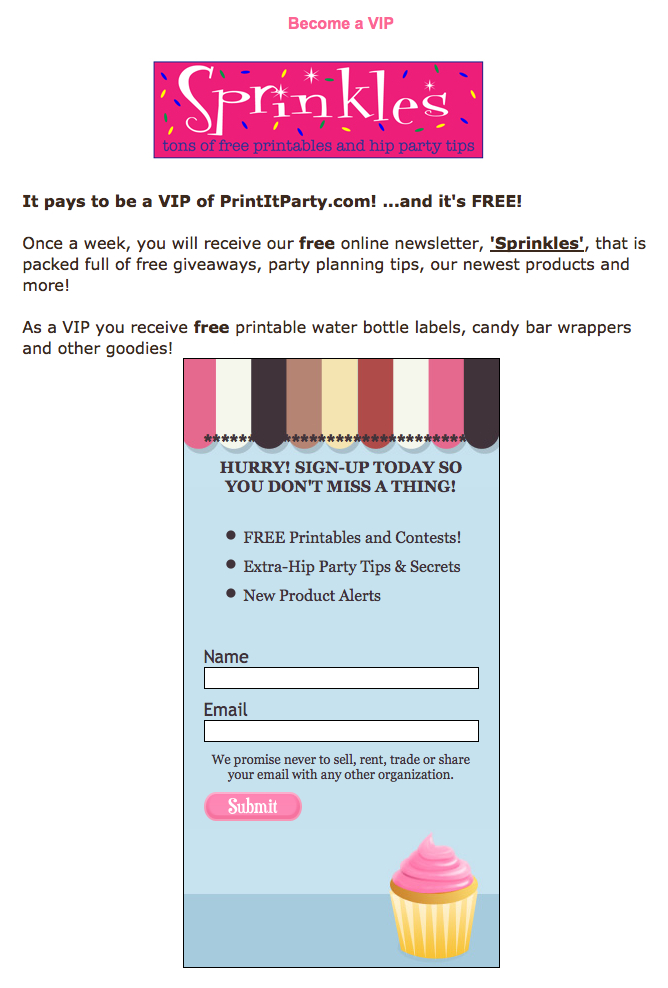
Let’s take a look at how Print It Party, a party decor site, sets expectations with their web form:

Print It Party Example thumbnailTo make certain that important details are not overlooked, they place information not only in the header of the form, but above the form as well. With your own form, if you can’t explain in full detail what subscribers will receive in just the header, include a description near the web form on the page.

This web form includes the benefits of what the subscriber will receive – “free printables and contests, extra-hip party tips and secrets and new products alerts.” They make their newsletter sound special and exciting while describing exactly what is to come.

Including a Subscriber Counter

Using a subscriber counter has shown to be a successful tool in gaining subscribers. A potential subscriber viewing the counter will see that others are benefiting from your newsletter. This establishes your information as a reputable source.

Battlefield Equipment, an equipment rental site, sets expectations using this method.

Battlefield Example thumbnailBattlefield Equipment’s subscriber counter builds trust and sets expectations about the quality of their “Battlefield Equipment eNewsletter.” Potential subscribers can see Battlefield already has a significant following and they will be more inclined to trust that the messages and content they will receive are valuable.

Just as Techbite describes when subscribers will receive messages, Battlefield notes that subscribers will get “seasonal” specials. If you do not send each week or month on a specific day, you can still use detailed words to describe “when” messages will go out.

Using Images

Including an image on your email sign up form can increase recognition and help you to maintain consistency throughout your campaign.

Take for example the web form on the homepage of the brain games and fitness company, Braintraining. Braintraining’s form includes imagery and lets subscribers know they respect their privacy.

Braintraining Example thumbnailTheir attention-grabbing lightbox form includes an image of the Brain Training Power Pack. Including this picture allows subscribes to visualize what they are going to receive.

The form also contains a link to Braintraining’s privacy policy. Include a link to the privacy policy in your own web form to assure subscribers that you are sending a safe and private newsletter.

Details Make the Difference

These forms do not simply say “Sign Up for My Newsletter.” They include valuable and descriptive information to begin an honest relationship with subscribers.

You can see a little detail goes a long way in setting expectations. To prevent potential complaints, make it your priority to set expectations right off the bat.

How do you set expectations at sign up?

Brought to you by Aweber

Seal the Deal: 10 Tips for Writing the Ultimate Landing Page

I have a client with a deep-pocket online media budget. Google Adwords PPC, banner ads on major news sites. We’re talking some sizable money to generate traffic and turn that traffic into customers. I bet you’re thinking a big part of their budget was earmarked for landing page development and testing. I would have thought so, too, before they became a client. But what I quickly discovered was this – there wasn’t a series of landing pages. There wasn’t even one landing page! All of the clicks, all of their costly PPC traffic was being directed to the homepage.

Literally, their best prospects were being dumped off at the front door with little direction or guidance as to how to proceed. Yikes.

Now just to be fair, literally any page of your site or blog is a landing page of a sort. To my mind, every page should be optimized to move your visitor along whatever path you’ve set forth toward a sale, a newsletter or blog subscription, what have you.

But for the purposes of this post, I’ll confine myself to those landing pages where your prospect initiated some sort of response to an ad. This could be a PPC (pay-per-click) ad like Google Adwords, a banner or text ad, or even an email. In this scenario, your prospect has initiated some sort of relationship with you. Your landing page acknowledges this and provides additional information – benefits/features – and a clear path to the next step.

So let’s look at 10 key steps to writing and designing a landing page that will help get you the results you’re looking for:

ON WRITING

1. Make sure your headline refers directly to the place from which your visitor came or the ad copy that drove the click. Match your language as exactly as you can. (Close is good, exact is best.) This way you keep your visitor oriented and engaged. This is by far the most important part of your landing page.

2. Provide a clear call to action. Whether you use graphic buttons or hot-linked text (or both), tell your visitor what they need to do. I use a minimum of 2 calls to action in a short landing page, 3-5 in a long landing page. Copy tests here will give you the biggest bang next to testing headlines.

3. Write in the second person – You and Your. No one gives a rat’s patootie about you, your company, or even your product or service except as to how it benefits him or her. (The bigger the company the more time I spend rewriting their stuff from We to You.)

4. Write to deliver a clear, persuasive message, not to showcase your creativity or ability to turn a clever phrase. This is business, not a personal expression of your art. (Every copy coaching student hears me say this at least once.)

5. You can write long copy as long as it’s tight. I always err on writing a little long on the first drafts because it’s easier to edit down than to pad up skimpy copy. Your reader will read long copy as long as you keep building a strong, motivating case for him/her to act. However, not every product or service will require the same amount of copy investment. Rule of thumb: Think longer copy when you’re looking to close a sale. Think shorter copy for a subscription sign-up or something that doesn’t necessarily require a cash commitment..

6. Be crystal clear in your goals. Keep your body copy on point as a logical progression from your headline and offer. Don’t add tangential thoughts, ancillary services, and generic hoo-hah. (Hoo-hah makes the client feel good but wastes the readers time.) Every digression is a conversion lost.

7. Keep your most important points at the beginning of paragraphs and bullets. Most visitors are skimming and skipping through your copy. Make it easy for them to get the joke without having to slow down.

8. In line with #7, people read beginnings and ends before they read middles. Make sure you keep your most critical, persuasive arguments in these positions.

9. Make your first paragraph short, no more than 1-2 lines (that’s lines, not sentences.) Vary your paragraph line length from here. It helps create visual dissonance and makes it easier to read your copy. And no paragraph should be more than 4-5 lines long at any time.

10. Write to the screen. Take a piece of paper and frame-out where your text, buttons, and design elements will go. Consider how much of your content will be seen “above the fold” or at the first screen. You can still go long and have visitors scroll downward. If so, you’ll want to make sure you repeat essential calls to action, testimonials and other components so no matter where your visitor is, an ACT NOW link or button remains is visible.

3 BONUS TIPS:

11. Remove all extraneous matter from your landing page. This includes navigation bars, visual clutter, and links to other sections. You want the reader focused solely on your copy, your supportive visuals, and the offer you’re making without being tempted to wander around the room.

12. Don’t ask for what you don’t need. Ask for only enough information to complete the sale or the desired action. This isn’t the time to conduct a marketing survey. Every question you ask, every piece of information you require will chip away at your response. Be judicious.

13. Assume nothing. Test everything.

These tips and techniques will get you started, but they just scratch the proverbial surface. Design elements are critical, too — color, images, layout — as well as video, audio, and other interactivity elements whose purpose is to more deeply engage the reader and boost response. They all merit a deeper look and testing where it makes sense.

Recommended Resource: The one book I recommend without reservation is Landing Page Handbook, How to Raise Conversions — Data & Design Guidelines. Published by Marketing Sherpa, this is a compendium of everything “landing page” that copywriters and designers should heed and study deeply. Not a cheap reference at $247, it is, however, the one to own if you’re serious about learning the science and technique behind great landing pages. (Alternatively, Try this Book by my friend Tim Ash)

Get more from Roberta Rosenberg at her blog, The Copywriting Maven.

Free Traffic Here.

Landing Page Optimization techniques and teaching.

Scrolling and Attention

Summary:
Web users spend 80% of their time looking at information above the page fold. Although users do scroll, they allocate only 20% of their attention below the fold.

In Web design, there’s much confusion about the “page fold” concept and the importance of keeping the most salient information within a page’s initially viewable area. (That is, in fact, the definition: “above the fold” simply means “viewable without further action.”)

During the Web’s first years, users often didn’t scroll Web pages at all. They simply looked at the visible information and used it to determine whether to stay or leave. Thus, in usability studies during that period (1994–1996), sites often failed if they placed important information below the fold as most users didn’t see it.

This reluctance to scroll made sense at the time, because people were used to having computers show all their choices. Dialog boxes, CD-ROM multimedia shows, and HyperCard stacks all worked that way, and didn’t require scrolling. (Although users sometimes encountered scrolling text fields, they didn’t need scrolling to see the commands and options, and could thus make all decisions from the visible info.)

In 1997, however, I retracted the guideline to avoid scrolling pages because users had acclimated to scrolling on the Web. This was a rare case in which usability guidelines changed quickly. Typically, usability findings are stable across many years: 80% of Web usability guidelines from the 1990s are still in force.

Today, users will scroll. However, you shouldn’t ignore the fold and create endless pages for two reasons:

  • Long pages continue to be problematic because of users’ limited attention span. People prefer sites that get to the point and let them get things done quickly. Besides the basic reluctance to read more words, scrolling is extra work.
  • The real estate above the fold is more valuable than stuff below the fold for attracting and keeping users’ attention.

So, yes, you can put information below the fold rather than limit yourself to bite-sized pages.

In fact, if you have a long article, it’s better to present it as one scrolling canvas than to split it across multiple pageviews. Scrolling beats paging because it’s easier for users to simply keep going down the page than it is to decide whether or not to click through for the next page of a fragmented article. (Saying that scrolling is easier obviously assumes a design that follows the guidelines for scrollbars and such.)

But no, the fact that users scroll doesn’t free you from prioritizing and making sure that anything truly important remains above the fold.

Information foraging theory says that people decide whether to continue along a path (including scrolling path down a page) based on the current content’s information scent. In other words, users will scroll below the fold only if the information above it makes them believe the rest of the page will be valuable.

Eyetracking Data

Last month, we conducted a broad eyetracking study of user behavior across a wide variety of sites. To investigate whether the “fold” continues to be relevant, I analyzed parts of the study with a total of 57,453 fixations (instances when users look at something on a page, typically for less than half a second).

To avoid bias, I only analyzed data from 21 users accessing 541 different Web pages, even though our full study was much larger. To convince you that I didn’t limit the data for nefarious reasons, let me explain why I excluded some parts of the study from the present analysis.

Because our research goal was to generate fresh insights for our annual conference seminars, we targeted large parts of the study to test:

  • sites with novel navigation features for the IA courses;
  • corporate blogs, interesting FAQs, etc., for the seminar on Social Features on Mainstream Sites and the two-day course on Writing for the Web; and
  • Web-based apps for the Application Design seminars.

For each specialized topic, it’s perfectly valid to target a study and test sites that have features that we want to investigate. For example, to gain insight into carrousels for our navigation seminar, we should track users’ eyes as they encounter carrousels. To do this, we simply ask them to use a site that happens to include a carrousel, but we don’t draw their attention to that design element.

When we deliberately ask people to test sites that contain particular design elements, we can’t conclude that their behavior is representative for average sites. Sticking with the carrousel example, people might well scroll less often than normal if the carrousel successfully keeps their attention on the upper part of the page.

Our study also featured a component that let users go to any site they wanted, for the sake of our broad-ranging seminar on Fundamental Guidelines for Web Usability. These non-constrained tasks are the source of the data I’m analyzing here, because they tested the regular websites people use, as opposed to sites we picked for their design features.

Attention Focused at the Top

The following chart shows the distribution of user fixations along stripes that were 100 pixels tall. The bars represent total gaze time, as opposed to the number of fixations. (In other words, two fixations of 200 ms count the same as one fixation of 400 ms.)

Bar chart of the distribution of gaze duration for Web page areas  100 pixels tall, starting at the top

Even though 5% of users’ total time is spent past the 2,000-pixel mark, they tend to scan information that far from the top fairly superficially: some pages are very long (often 4,000+ pixels in my sample), and thus this 5% of user attention is spread very thinly.

In our study, user viewing time was distributed as follows:

  • Above the fold: 80.3%
  • Below the fold: 19.7%

We used an eyetracker with a resolution of 1,024 × 768 pixels. These days, many users have somewhat bigger screens, and we’ve conducted many (non-ET) usability studies with larger resolutions. Although using a bigger monitor wouldn’t change my conclusions, it would somewhat increase the percentage of user attention spent above the fold simply because more info would be available in the initially viewable space.

Scrolling Behaviors

Sometimes, users do read down an entire page. It does happen. Rarely.

More commonly, we see one of the two behaviors illustrated in the following gaze plots:

Gaze plots of viewing behaviors on three very long pages that all  were scrolled almost to the bottom.
Gaze plots showing where three users looked while visiting pages during three different tasks (one test participant per page). Each blue dot represents one fixation, with bigger dots indicating longer viewing time.

On the left, the user scrolled very far down the page and suddenly came across an interesting item. This viewing pattern gives us many fixations that are deep below the fold. We often see this pattern for well-designed FAQs, though the best FAQs present the most frequently asked questions at the top (so that many users won’t need much scrolling).

The left gaze plot also illustrates another point: the last element in a list often attracts additional attention. The first few items are definitely the most important, but the final item gets more views than the one before it. (That’s also why the bar chart shows more attention to the 701–800 pixel area than to the 601–700 pixel area: the bottom of our study monitor fell within the former area.) The end of a list’s importance is further enhanced by the recency effect, which says that the last thing a person sees remains particularly salient in the mind. (We discuss the design implications of the recency and primacy effects in our seminar on The Human Mind and Usability.)

The two other gaze plots show more common scrolling behaviors: intense viewing of the top of the page, moderate viewing of the middle, and fairly superficial viewing of the bottom. (I picked examples where users scrolled more or less all the way down — often there’s no viewing of the bottom because users don’t scroll that far.)

It’s as if users arrive at a page with a certain amount of fuel in their tanks. As they “drive” down the page, they use up gas, and sooner or later they run dry. The amount of gas in the tank will vary, depending on each user’s inherent motivation and interest in each page’s specific topic. Also, the “gasoline” might evaporate or be topped up if content down the page is less or more relevant than the user expected.

In any case, user attention eventually peters out, and the further down the page users go, the less time they generally spend on each additional information unit.

The middle gaze plot shows a category page with 50 sofas:

  • The top 2 rows get about 5–10 fixations per sofa.
  • The next 4 rows get around 2–4 fixations per sofa.
  • The next 8 rows typically get 1 fixation per sofa.
  • The bottom 3 rows get 2 fixations for one sofa and no fixations for the remaining 7 sofas.

This is only a rough pattern, and users will deviate depending on the content. For example, the Cameon Loveseat and the Custom Hugo Loveseat both get 4 fixations despite being 2,750 pixels down the page. Presumably, the user found these two sofas particularly appealing.

Design Implications

The implications are clear: the material that’s the most important for the users’ goals or your business goals should be above the fold. Users do look below the fold, but not nearly as much as they look above the fold.

People will look very far down a page if (a) the layout encourages scanning, and (b) the initially viewable information makes them believe that it will be worth their time to scroll.

Finally, while placing the most important stuff on top, don’t forget to put a nice morsel at the very bottom.

Check out CPAWAY: The Leading Affiliate Network doing it Your Way!

—–
Jakob Nielson is the leading expert in Internet Usability

5 Landing Page Mistakes that Crush Conversion Rates

Sponsored by the Great Affiliate Team at AffiliateWise. Sign up Today!

A landing page is a place you send traffic when you really want some action. And no, this has nothing to do with Craig’s List personals. It can be a sales page, an email opt-in page, a video landing page, or even a content landing page designed to rank well in search engines. As you might have guessed, there are a lot of ways to screw these up. Here are five of the most common mistakes people make with their landing pages. More importantly, I’ll tell you how to avoid making them yourself.

1. Blowing the headline

Landing pages live or die by the quality of the headline. It’s your two-second chance to overcome the swift and brutal attention filters we’ve developed due to information overload and poorly-matched promises.

Often, a better headline alone will boost the effectiveness of your landing page, and even overcome some of the other mistakes below. Split-testing different headlines is relatively painless, and can bring you much higher conversions compared with multiple other tweaks.

2. Using your regular site design

Most of us who use content marketing as an attraction strategy use a content management system, such as WordPress. That means we’re using design themes for the visual presentation of our sites.

While your typical sidebar and header approach to a blog post is fine, when it comes down to traffic hitting a landing page with a singular focus on specific action, all of that extraneous stuff causes confusion, distraction, and reduced conversions. Lose the clutter and create the cleanest page possible when you want some action.

3. Asking for more than one thing

The idea that more choices make people happier has been proven to be a psychological fallacy time and again. This “paradox of choice” reveals that when given multiple options, the decision ends up being not to choose at all.

An effective landing page asks for one specific action, and that’s it. And don’t forget to actually clearly ask for that one specific thing, which is an even bigger conversion killer if you don’t.

4. Ignoring basic aesthetics

Why is it when some people decide to ask for some action, they lose their minds on the appearance of the page? Bad fonts, garish colors, cheap highlighting, and silly clip art do not make for better conversions in most cases. What they do is crush your credibility.

While using your standard blog theme is distracting and confusing in the landing page context, there’s no need to become the typographical equivalent of a carnival barker, either. Great landing pages use fonts, colors, and visuals that are tailored specifically to the audience and action you desire, thereby enhancing the experience and boosting conversions.

5. Being lazy

Did you know that web users spend 80% of their time above the fold? Does that mean people won’t scroll down the page? No, it just means you can’t take it for granted that they will (instead of leaving).

Don’t be lazy about grabbing and holding attention. Don’t assume everyone instantly “gets” the benefit of your offer the way you do. Don’t overestimate your credibility. In short, don’t drink your own Kool-Aid. Think about it from their perspective, and you’ll realize you might not be all that (until you unequivocally prove you are with compelling copy).

Learn how to get Free Mass Traffic

—–

About the Author: Brian Clark is founder of Copyblogger and CEO of Copyblogger Media. Get more from Brian on Twitter.